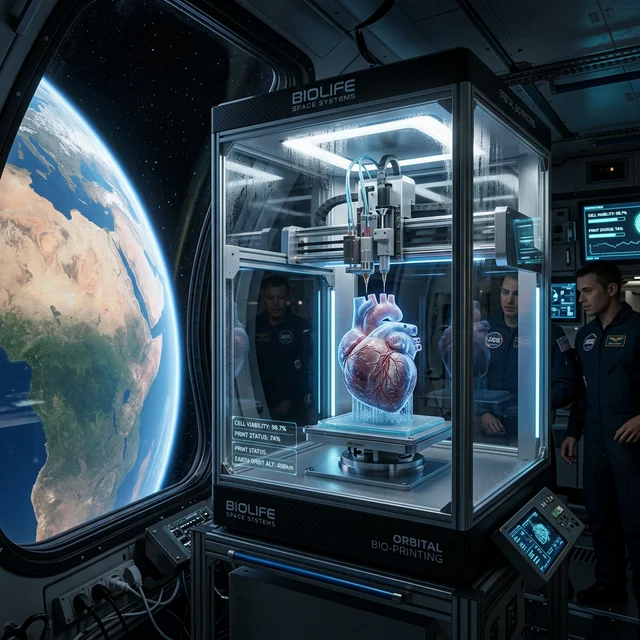
Medicine Beyond Earth's Pull
On March 18, 2026, the medical and aerospace worlds converged in a historic milestone. Researchers aboard the privately funded Aura Space Station have successfully completed the first functional 3D-bioprinting of a complex human heart valve in a zero-gravity environment. This achievement, part of the 'Vitals-Orbit' initiative, proves that the vacuum and microgravity of space offer the perfect conditions for growing complex biological structures without the structural collapse often seen in Earth-bound labs.
The Advantage of Microgravity
On Earth, gravity acts as a constant downward force that requires 'scaffolding' or chemical supports to keep 3D-printed cells from flattened into a puddle. In orbit, tissues can be printed in three dimensions simultaneously, allowing for the creation of intricate vascular networks and delicate cellular architectures that are currently impossible on the surface. "Space isn't just a place to explore; it's the ultimate incubator," said Dr. Elara Vance, lead scientist at BioLife Space Systems.
From Orbit to Operating Room
The bioprinted valve is currently undergoing cryostasis for its return journey to Earth next month. Once back, it will enter clinical trials for a select group of patients awaiting transplants. If successful, this process could virtually eliminate the organ donor waiting list by the end of the decade, turning commercial space stations into the primary manufacturing hubs for custom-grown human organs.












































































Join FuturEdge to share your thoughts on this article.