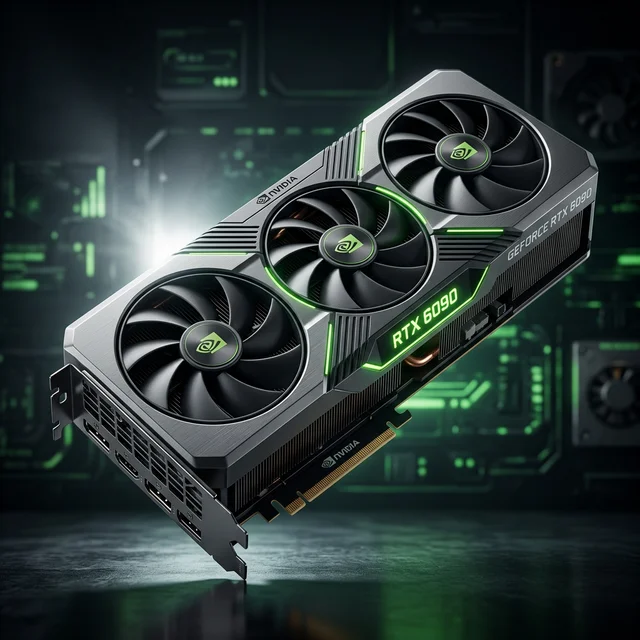
This Isn't a Review — The Card Hasn't Launched
Nvidia has not announced, let alone shipped, an RTX 6090. Every spec in circulation — CUDA core counts, memory configuration, benchmark numbers — comes from unverified leaks, not an official Nvidia announcement or independent hands-on testing. We're reframing this as a leak roundup rather than a review.
What the Leaks Actually Say
Rumored specs point to the RTX 60 series using Nvidia's Rubin architecture on TSMC's 3nm process, with the flagship reportedly carrying 32GB of memory on the GR202 die with up to 192 streaming multiprocessor units across a 512-bit memory bus. Leaked performance estimates suggest roughly 2x the path-tracing performance and 30-35% higher raw raster performance versus the RTX 50 series, with newer-generation RT and Tensor cores.
Timeline Has Slipped
Earlier rumors pointed to a second-half-2027 launch for the RTX 60 series; more recent reporting suggests that could slip further to 2028, as Nvidia prioritizes AI accelerator production for data centers amid memory shortages over consumer gaming GPUs.
The Takeaway
Treat any "RTX 6090 review" as fiction until Nvidia actually announces the card — current-generation RTX 50-series cards remain the real flagship options for the foreseeable future.
Sources
- NVIDIA GeForce RTX 6090: Detailed Specifications and Benchmark Ratings — CpuTronic
- New RTX 60 series specs leak suggests huge RT performance and memory bandwidth improvement — TweakTown
- NVIDIA GeForce RTX 6090 Graphics Card — VideoCardz
The RTX 6090 Does Not Yet Exist
As of mid-2026, Nvidia has not released any RTX 6090 or RTX 60-series product. Coverage describing an "RTX 6090 review" should be read as speculative reporting on a hypothetical future product.
What the RTX 5090 Actually Delivers
The RTX 5090 (released January 2025, MSRP $1,999; actual market price higher due to supply constraints) uses Nvidia's GB202 die on TSMC's 4N process. Key specifications: 21,760 CUDA cores, 32 GB GDDR7 memory with 1,792 GB/s bandwidth, 575W TDP. Performance at 4K gaming is approximately 40–60% faster than the RTX 4090 in tested titles, with the largest gains in games using DLSS 4 and Multi Frame Generation.
For most users, the RTX 5080 ($999 MSRP) or 5070 Ti provides better price-to-performance than the 5090.
When the Next Generation Might Appear
Nvidia's consumer GPU cadence has been approximately 24 months between architectural generations: Ada Lovelace (40 series) launched late 2022; Blackwell (50 series) launched January 2025. Based on this cadence, a next-generation architecture would most likely target late 2026 or early 2027. Nvidia has not confirmed any specific product or timeline for what follows Blackwell in the consumer lineup.
What to Expect From Rubin (Rumoured Next Architecture)
Nvidia's next-generation compute GPU architecture has been publicly named "Rubin" (for data centre). Whether Rubin or a consumer variant appears in late 2026 depends on TSMC's N2 process readiness and Nvidia's production scheduling priorities — data centre demand for Blackwell is currently so strong that diverting production to consumer products has limited appeal.
Buying Advice for Right Now
If you need a new GPU today: the RTX 5080 at $999 MSRP ($1,200–$1,400 actual market) offers the best performance-per-dollar in Nvidia's lineup. The 5090 is for users with a specific need for maximum performance and willing to pay a significant premium. If you can wait until late 2026 or Q1 2027, next-generation products from both Nvidia and AMD may offer a compelling reason to hold off — but GPU launch cycles have been subject to delays, and waiting is always uncertain.



































































Commenting is currently unavailable on this article.