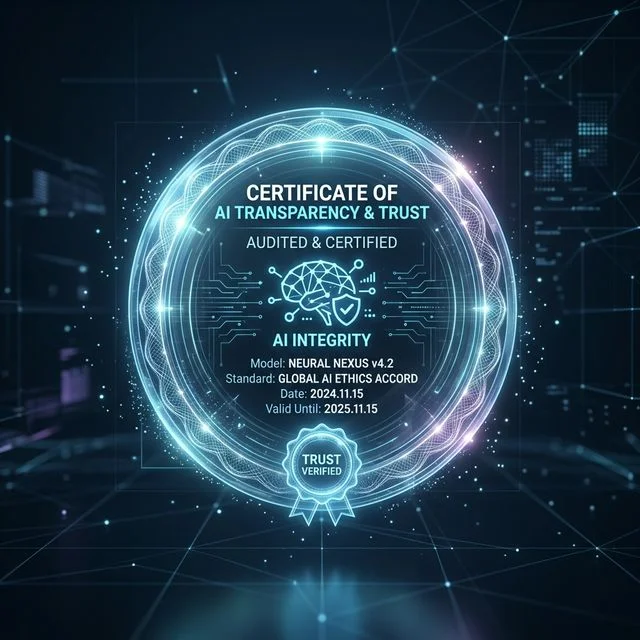
Establishing a Standard for Trust
In a world where AI agents can operate independently, how do we know they are acting ethically? March 2026 marks the widespread adoption of Transparency Certificates. These digital audits provide verifiable proof of a model's training data, bias mitigation, and safety guardrails, becoming as essential as a SSL certificate for any serious AI deployment.
Verifiable Safety Protocols
The move toward certification was accelerated by the Singapore SEZ's requirement for clear algorithmic accountability. These certificates don't just look at the code; they use AI 'Stress Testers' to verify that the agent will adhere to its constraints even in speculative or edge-case scenarios.
Global Regulation and Innovation
While some fear that regulation stifles innovation, the Transparency Certificate standard is actually driving it. By providing a clear framework for 'Ethical Scaling,' companies can deploy autonomous corporations with confidence. Trust has become the most valuable currency in the AI landscape, and those with the highest certification levels are winning the market.
Who Is Issuing These Certificates
The emerging transparency certification ecosystem now features several competing bodies, including the IEEE's AI Ethics Certification Program, the EU's AI Act compliance certification under the EUAIA framework, and the private Responsible AI Institute's auditing standard. None yet holds universal recognition, creating a patchwork of standards that enterprise buyers must navigate. The most commercially significant development has been major cloud providers — AWS, Azure, and Google Cloud — announcing they will require third-party transparency certificates for AI services offered through their enterprise marketplaces by the end of 2026.
What a Certificate Actually Covers
A rigorous AI transparency certificate audits four primary dimensions: the provenance and composition of training data, the bias mitigation techniques applied during training and fine-tuning, the safety guardrails and refusal mechanisms active at inference time, and the human-oversight provisions built into the deployment architecture. Obtaining certification typically takes between four and twelve weeks and costs between $50,000 and $250,000 depending on model complexity and auditor. Critics argue that certificates are only as reliable as the auditing bodies issuing them, and that without standardised testing protocols, the market risks creating a checkbox compliance culture rather than genuine accountability.
What Transparency Certificates Actually Certify
The concept that has gained traction in 2026 is not a single standard but a category: third-party assessments of AI systems that result in a published statement of what the system was trained on, what guardrails are implemented, what testing was performed, and what known limitations exist. Several organisations are now issuing these certificates:
METR (Model Evaluation and Threat Research) — an independent lab that conducts capability assessments of frontier AI models, focusing specifically on dangerous capability thresholds (biosecurity, cyberoffense, autonomy). Anthropic, Google DeepMind, and OpenAI have all engaged METR for pre-deployment evaluations.
AI Now Institute — produces accountability audits focusing on civil rights, labour, and fairness dimensions of deployed systems, particularly in high-stakes contexts (hiring, credit, criminal justice).
Bureau of AI Safety (UK) — the UK's AI Safety Institute conducts evaluations of frontier models and publishes findings. The institute has an agreement with the US AI Safety Institute for joint evaluations.
The EU AI Act Connection
The EU AI Act's risk classification framework creates a legal mandate for transparency documentation for high-risk AI systems. Systems used in employment, credit, education, law enforcement, and critical infrastructure must maintain conformity documentation that is available to national competent authorities. The AI Act's transparency certificates requirement is distinct from the voluntary third-party certificates above — it is a compliance obligation, not a reputational signal.
The Fundamental Limitation
No transparency certificate can fully verify what a model "knows" or will do in edge cases. The evaluations are necessarily bounded by the test sets the auditors can construct. A model may pass every structured evaluation while still producing harmful outputs in scenarios the evaluators didn't think to test. Certificates establish a baseline of documented responsibility, not a guarantee of safe behaviour — a distinction that is easy to lose in how they are sometimes marketed.
























































Commenting is currently unavailable on this article.