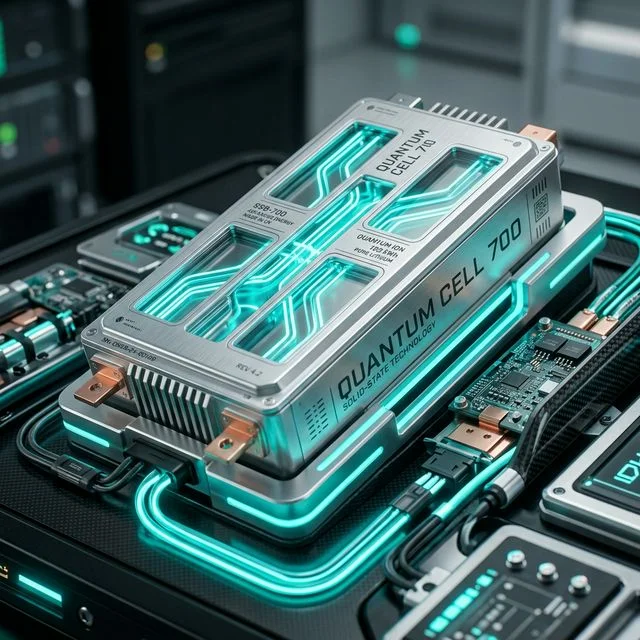
The End of Range Anxiety
In a historic announcement for the automotive industry, QuantumScape has officially validated its 'QS-Alpha' solid-state battery technology for mass production. The new cells, which utilize a proprietary ceramic separator, have demonstrated an energy density that is 40% higher than today's best lithium-ion batteries. This breakthrough effectively sets a new standard for EVs: the 1,000km (620-mile) single-charge range.
Faster Charging, Longer Life
Beyond range, the QS-Alpha cells solve the two biggest pain points for EV owners: charging speed and degradation. These solid-state batteries can charge from 10% to 80% in just under 12 minutes without the risk of thermal runaway. Furthermore, testing indicates that the batteries retain 95% of their capacity after 1,000 full charge cycles—potentially outlasting the vehicles they power.
2027: The Year of the Solid-State EV
Major partners, including the Volkswagen Group and upcoming luxury EV startups, have already begun integrating these cells into their 2027 design cycles. While the cost remains higher than traditional lithium-ion for now, QuantumScape expects economies of scale to bring prices down to parity by 2030. This is the moment when the internal combustion engine truly becomes a relic of the past.
The Strategic Mineral Shift
The move to solid-state chemistry also reduces the industry's reliance on cobalt and liquid electrolytes, potentially stabilizing the supply chain and making EV production more environmentally sustainable than ever before.
What QuantumScape Has Demonstrated
QuantumScape's 2026 milestone reports from its QS-0 pre-production pilot line are the most credible version of its solid-state technology yet demonstrated: cells achieving 400+ charge cycles while retaining over 80% initial capacity (the automotive warranty threshold), 15-minute 10-80% charge at room temperature, and energy density approximately 10-20% above leading lithium-ion cells.
The gap between these results and commercial production remains significant. QuantumScape's pilot line output is measured in thousands of cells — automotive volumes require hundreds of millions annually.
The Volkswagen Relationship
Volkswagen's PowerCo battery subsidiary is engaged in joint development but has not confirmed commercial supply commitments at volume. QuantumScape's path to commercialisation runs directly through this relationship — it has no standalone manufacturing operation.
What the Stock Reflects
QuantumScape's share price (NASDAQ: QS) is highly sensitive to milestone announcements and partnership news. The gap between laboratory or pilot-line performance and commercial manufacturing has disappointed investors multiple times since the company went public via SPAC in 2020. Patient investors are betting on the technology eventually reaching commercial viability; skeptics argue that manufacturing challenges will continue pushing the timeline out. Both positions have been validated and falsified alternately over the past five years.
The Investor Reality Check
QuantumScape has missed commercial milestones repeatedly since its 2020 SPAC listing. The pattern — promising pilot results followed by timeline delays — has repeated four times. Each iteration has also shown genuine technical progress, however: the cycle count data is better, the temperature performance is broader, and the manufacturing understanding is deeper than five years ago. Investors in NASDAQ: QS are betting that this time the manufacturing scale-up succeeds; the risk is that another delay is announced. Position sizing consistent with that binary uncertainty is the appropriate framework.
























































Commenting is currently unavailable on this article.