
Eight Years Later, a Final Verdict
The Court of Justice of the European Union (CJEU) dismissed Google's final appeal in early July 2026, upholding a €4.1 billion fine — roughly $4.7 billion at current exchange rates — originally imposed by the European Commission in 2018. The ruling is legally binding and exhausts Google's appeal options within the EU court system, making the penalty permanent.
What Google Actually Did
The European Commission found that Google abused its dominant position in three connected ways. First, it required device manufacturers who wanted to pre-install Google Play — Android's app store — to also pre-install the Google Search app and Chrome as the default browser. Second, it paid manufacturers financial incentives to exclusively pre-install Google Search on their devices. Third, it prevented manufacturers from selling devices running modified versions of Android that didn't carry Google's full suite of apps.
The Commission's core argument was that Google used Android's position as the world's dominant mobile operating system as a lever to entrench its search and browser dominance — and that these practices denied competitors a fair opportunity to establish themselves on Android hardware. At the time the fine was imposed, Android ran on roughly 80% of smartphones globally.
What Changed After 2018
Google did make changes after the original fine was imposed. The most visible was a "choice screen" introduced in Europe in 2019, which prompted users setting up new Android devices to choose their preferred browser and search engine from a list. The implementation was initially criticised — Google originally charged rival search engines for positions on the choice screen — and was revised after further regulatory pressure.
By most independent assessments, Google's market share in European mobile search declined modestly after the choice screen was introduced, from roughly 96% to around 91%, but remained dominant. Critics argued the remedies were insufficient; Google argued the competition had simply not won users' voluntary preference.
Google's Full EU Antitrust Record
This is not an isolated case. The EU has pursued three major antitrust actions against Google:
The Shopping case (2017) resulted in a €2.42 billion fine for favouring Google Shopping results in search. Google lost its final appeal in that case in 2021.
The Android case (2018) is the one just concluded — €4.1 billion, now permanent.
The AdSense case (2019) resulted in a €1.49 billion fine for restricting rivals from placing competing search ads on third-party websites. That case is still working through appeals.
Combined, these three cases represent €8 billion in EU fines that Google is either paying or contesting — the largest antitrust enforcement action against a single company in history.
Comparison with Apple's EU Regulatory Battles
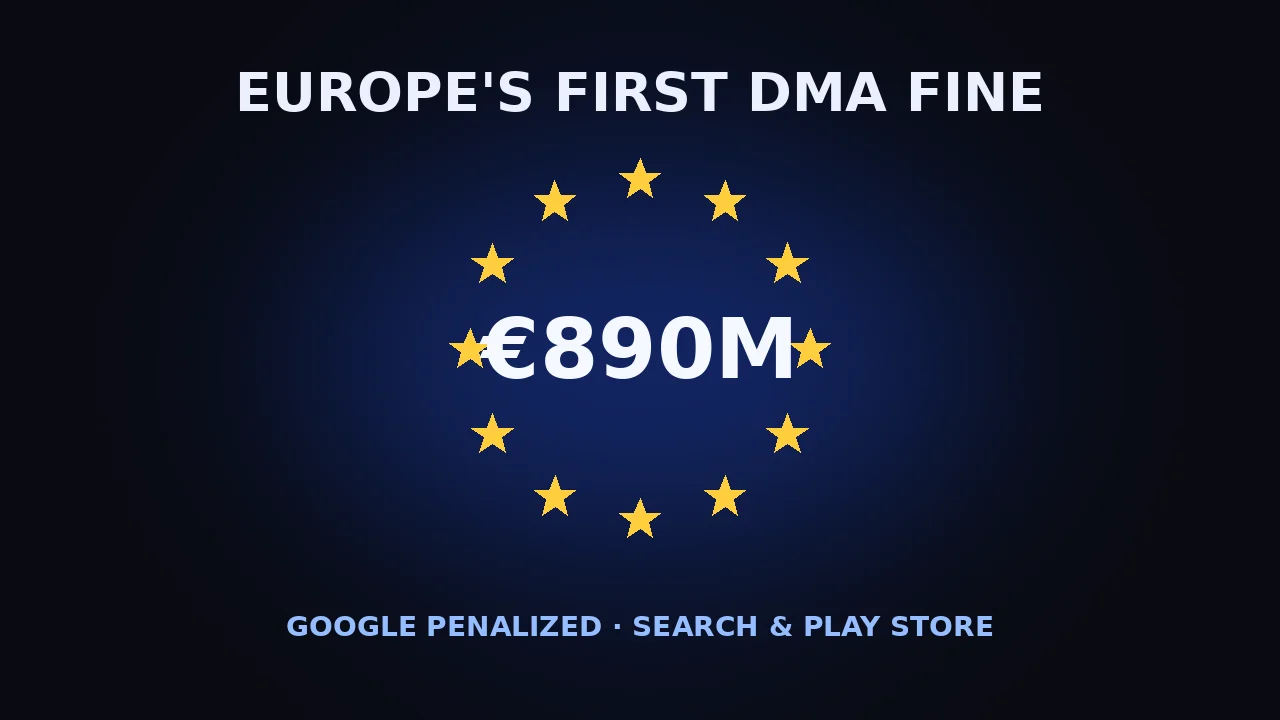
The Alphabet/Google cases are running in parallel with Apple's own EU regulatory exposure. The Digital Markets Act, which came into force in 2024, designated both companies as "gatekeepers" with additional obligations around interoperability, sideloading, and default-app competition. Apple paid a €500 million DMA fine in early 2025 for its App Store compliance approach and is fighting additional enforcement actions.
The overall picture in Brussels is of a regulatory regime that has moved from case-by-case antitrust enforcement to structural obligations imposed on the largest platform companies — a shift with implications well beyond fines.
What Happens Now
Google must pay the €4.1 billion penalty. The company has been setting aside funds for this contingency since 2018 and the payment itself is not expected to create financial difficulty — Alphabet's annual revenue exceeds $350 billion. The more significant consequence is precedential: the CJEU's ruling affirms the Commission's theory of harm and makes it easier to bring future cases involving the same type of pre-installation leverage.
For Android device manufacturers, the ruling doesn't directly change their current obligations — those were already reshaped by the 2019 remedies. For Google, the larger threat now is the DMA's structural requirements, which go further than the 2018 fine in what they demand from the company's day-to-day product decisions.
The Bottom Line
The CJEU ruling closes the legal chapter on a case that opened when Android was a very different product in a very different competitive landscape. The €4.1 billion fine is large in absolute terms but represents less than two weeks of Alphabet's revenue at current rates — a meaningful but not existential outcome. The more important development is structural: the Digital Markets Act has already replaced litigation with standing obligations, requiring Google to make ongoing behavioral changes rather than simply paying a one-time penalty and continuing as before. The era of the European Commission chasing past behavior with multi-year cases is giving way to prospective rules with shorter enforcement timelines.
Key Numbers and Timeline
2018 — European Commission imposes €4.1 billion fine. 2022 — General Court of the EU partially upholds fine, reduces to €4.125 billion. 2026 — CJEU dismisses final appeal; €4.1 billion penalty confirmed permanent. Google's total EU antitrust fines across three cases: approximately €8 billion. Alphabet's 2025 annual revenue: approximately $350 billion. The Android fine represents roughly 4.25 days of Alphabet revenue at 2025 rates. Number of Android OEMs currently shipping devices with Google's full app suite globally: over 1,300.
What does this mean for consumers? The practical impact on everyday Android users in 2026 is limited. The choice screen introduced after the 2018 fine has been running for years; most users have already set their browser and search preferences. The ruling's most significant effect is on the legal precedent it creates for future antitrust enforcement against large technology platform companies in Europe and in jurisdictions that look to EU case law as a model.































































Commenting is currently unavailable on this article.