
The Era of the AI Manager
Today, March 16, 2026, OpenAI has officially launched O3-Orchestrator, a system that many are calling the first 'Operating System for the Agentic Era'. No longer just a chatbot, O3 acts as a conductor for a symphony of specialized agents, each expert in niches from financial modeling to creative direction.
Seamless Collaboration
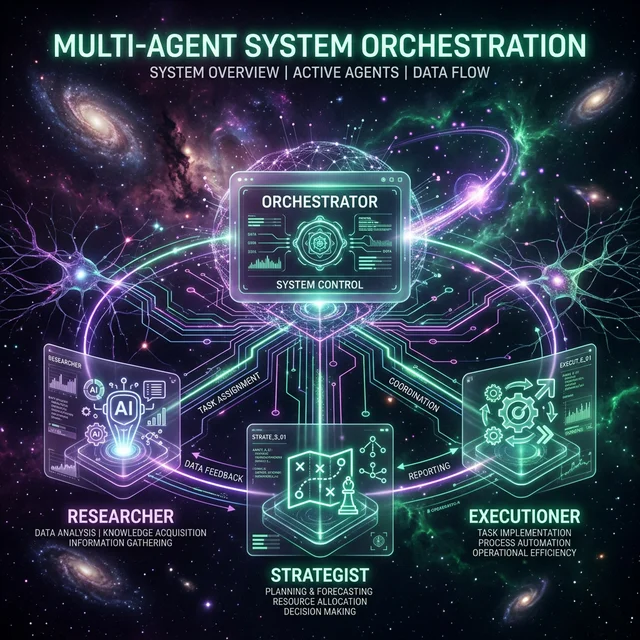
The breakthrough lies in the 'Inter-Agent Communication Protocol' (IACP). When a user gives a high-level goal, O3 automatically spins up a project team. For example, a request to 'launch a local marketing campaign' triggers a Researcher Agent, a Copywriter Agent, and a Media Buying Agent. They communicate with each other in the background, only surfacing to the user for final approvals and strategic pivots.
Impact on Productivity
Early testers from the Fortune 500 report that task completion times for complex projects have dropped by an average of 65%. By removing the need for humans to manually 'prompt-engineer' every interaction between different AI tools, OpenAI has simplified the path to true autonomous business operations.
Competitive Context and What It Means for the Agentic Market
The O3-Orchestrator launch arrives into a competitive field that includes Anthropic's Claude agent frameworks, Google's Vertex AI Agent Builder, and a growing ecosystem of open-source orchestration tools including LangGraph and CrewAI. OpenAI's differentiator is tight integration with its existing GPT-4 and GPT-4o model family and a native connection to its Assistants API infrastructure, which already hosts tens of thousands of enterprise deployments. The pricing model — per-agent-action billing rather than per-token — represents a significant commercial architecture shift that is easier to budget against for enterprises running defined business processes.
Early Enterprise Reception and Limitations
Early access customers — primarily from financial services, healthcare administration, and software development — report that the orchestration layer works reliably for well-defined, structured workflows but struggles with ambiguous or highly context-dependent tasks where agent selection requires nuanced judgment. The handoff between agents also introduces latency that is non-trivial for time-sensitive applications; a workflow that passes context between five agents may take 45–90 seconds end to end, which is acceptable for back-office automation but insufficient for customer-facing interactions where sub-second response times are expected. OpenAI's engineering team has indicated that a caching layer and pre-warmed agent pools are on the near-term roadmap to address the latency limitation.
What O3-Orchestrator Actually Does
The O3-Orchestrator is built on the same reasoning model architecture as OpenAI's o3, which demonstrated strong performance on complex multi-step problem-solving benchmarks. The Orchestrator adds a meta-level planning capability: given a complex goal, it can decompose the work into subtasks, assign each subtask to a specialised sub-agent (a web search agent, a code execution agent, a data analysis agent), coordinate their outputs, and synthesise a final result.
This is distinct from simply calling tools in sequence. An orchestrator manages parallel execution (multiple agents working simultaneously on different subtasks), handles errors and retries at the subtask level without the overall task failing, and maintains a consistent representation of the goal across the entire workflow.
Real-World Use Cases in Early Deployment
Enterprise customers in OpenAI's early access programme have reported using O3-Orchestrator for: competitive intelligence gathering (the orchestrator plans a research workflow, dispatches web agents to gather recent developments on specified companies, synthesises findings into a structured brief), software debugging (the orchestrator manages a workflow across code reading, test execution, and fix generation agents), and financial modelling (coordinating data retrieval, formula generation, and narrative synthesis across structured and unstructured data sources).
The Pricing and Access Model
O3-Orchestrator is priced at the API level per orchestration unit — a metric that accounts for the compute used across all sub-agents in a workflow rather than a simple per-token model. OpenAI has not published a specific public price per orchestration unit, but beta testers have reported costs in the range of $0.50–$5.00 per completed multi-step workflow, depending on complexity. This pricing model is intended to reflect the compound cost of running multiple agents in parallel rather than a single inference call.
































































Commenting is currently unavailable on this article.