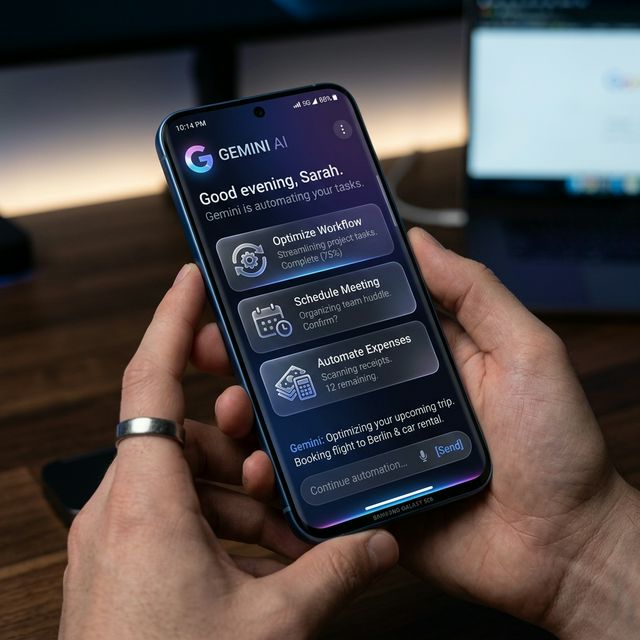
The New Standard for Mobile Intelligence
Late March 2026 marks a watershed moment for personal computing. With the official rollout of the Samsung Galaxy S26, the promise of a truly agentic smartphone has finally been fulfilled. At the heart of this device is a specialized version of Gemini AI, optimized for local task automation. This isn't just another voice assistant; it is a proactive logic engine that handles complex workflows across every installed application.
Gemini AI Trends 2026: From Chat to Action
One of the most significant Gemini AI trends in 2026 is the shift from generative text to structured action. On the Galaxy S26, Gemini can coordinate between your calendar, email, and banking apps with zero human intervention. For example, a user can simply say, "Plan my business trip to Tokyo," and the AI will book flights, reserve hotel rooms, and schedule meetings based on historical preferences and real-time availability.
AI Task Automation on Smartphones: Local and Secure
Security is the cornerstone of this new expansion. By utilizing neuromorphic edge compute, the S26 processes AI task automation locally. Your intent and data never leave the device, addressing the growing demand for privacy in an increasingly automated world. This localized intelligence is also fueling a surge in open-source AI trends, as developers leverage the S26's open APIs to build cross-platform automation tools that bypass centralized cloud silos.
The Open-Source Response
As Google and Samsung lead the proprietary charge, the open-source community is responding with decentralized models that rival Gemini's efficiency. These models are increasingly being integrated into the agentic economy, proving that the future of AI is not a walled garden, but a transparent, collaborative ecosystem. The Galaxy S26 is more than a phone; it is the first true node in a global, intelligent network.
What Gemini Integration on Galaxy S26 Actually Offers
Samsung's Galaxy S26 is the first Android flagship to deeply integrate Google's Gemini AI across the operating system rather than as a separate app. The specific features include:
Circle to Search (already live on S25) — drawing a circle around any on-screen content triggers a contextual Gemini search without leaving the current app. The S26 adds AI-generated summaries within the search results, not just web links.
Gemini Live — an always-available conversational AI overlay that can see the phone's screen contents via screen sharing and provide contextual assistance. Unlike a search query, Gemini Live maintains context across a conversation, functioning more like a persistent AI assistant than a query-response tool.
Photo Assist with Gemini — AI editing features in the native camera and gallery app use Gemini models for generative fill (removing and replacing objects), object removal, and style transfer. Previously, these features required Google Photos; they are now native to Samsung's own gallery.
Galaxy AI translation — Real-time call translation (converting spoken language during a phone call) uses on-device Gemini Nano for the initial pass, with cloud-side Gemini Pro handling complex phrasing.
The Open-Source Gemma Context
Google's decision to release the Gemma family of open-weight models (Gemma 1, 2, and 3) has changed the competitive dynamics in the open-source AI space. Gemma 3's 27B parameter model achieves performance comparable to much larger models on key benchmarks, while the 1B and 4B versions are specifically optimised for on-device deployment on Android hardware. This gives Samsung's AI features a credible offline option for privacy-sensitive use cases, operating without data leaving the device.
The broader ecosystem effect of Gemma's open-source release is significant: developers building Android applications can fine-tune and deploy Gemma locally, integrating AI capabilities without routing data to Google's cloud — a meaningful option for enterprise applications with data compliance requirements.





























































Commenting is currently unavailable on this article.