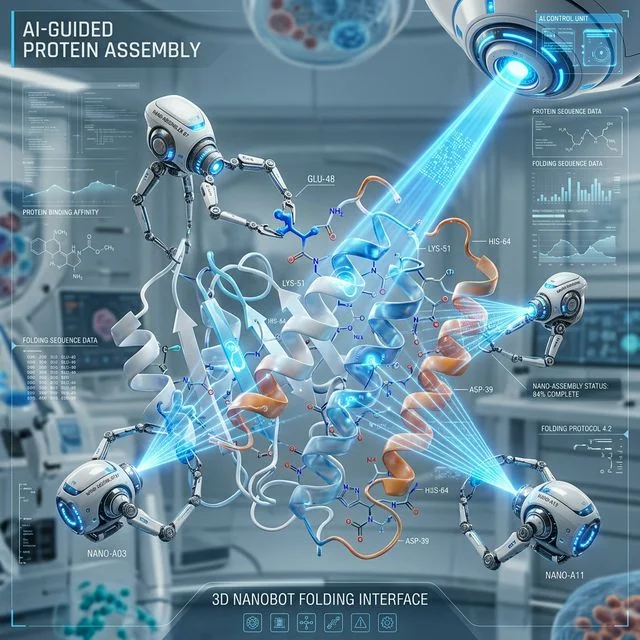
The Era of Generative Biology
The medical breakthroughs of March 2026 are not coming from labs alone, but from generative neural networks focusing on protein folding. Generative Biology is now a reality, with AI designing custom-built proteins that can target specific diseases based on a patient's DNA. This is the ultimate promise of personalized medicine fulfilled.
From Discovery to Design
Unlike traditional drug discovery, which is a process of 'trial and error,' AI-driven protein design is a process of 'intent.' Researchers specify the desired therapeutic effect, and systems like Personalized AI Ensembles generate the molecular blueprints. This has already led to successful trials in regenerative limb medicine.
The Hospital of the Near Future
Within the next few years, we expect hospitals to have 'local protein printers' that create patient-specific doses onsite. This decentralized medical model, combined with neuromorphic edge compute for real-time patient monitoring, is transforming healthcare into a proactive, preventative, and precisely targeted science.
From Lab to Clinical Pipeline
The gap between in silico protein design and clinical application remains significant, but it is narrowing faster than most biomedical researchers expected five years ago. Companies like Isomorphic Labs, a Google DeepMind spin-off, and Recursion Pharmaceuticals are currently in pre-clinical and early Phase I trials with drug candidates that were identified entirely through AI-driven protein structure prediction and generative design. The FDA's Centre for Drug Evaluation has opened a dedicated Computational Drug Design pathway that allows AI-designed candidates to submit abbreviated pre-clinical packages when supported by sufficiently robust in-silico validation data, accelerating the timeline from candidate selection to first-in-human trials.
The Personalized Medicine Horizon
Truly patient-specific protein therapeutics — designed from an individual's genomic and proteomic profile — remain further away than the most optimistic projections suggest. The core bottleneck is not computational but clinical: manufacturing a bespoke biologic for a single patient at a cost that healthcare systems can bear is an unsolved problem. Current efforts focus on identifying highly targeted therapies for rare genetic diseases, where patient populations are small enough that highly customised treatments are economically viable and where the clinical need is sufficiently unmet to justify the development cost.
The Specific Therapeutic Categories Being Targeted
Generative AI protein design is most advanced in three therapeutic areas where the technical fit between AI capabilities and clinical need is tightest:
Rare genetic diseases — Conditions caused by loss-of-function mutations in a specific protein are natural targets for replacement or correction therapies. AI can design proteins that either mimic the missing function or deliver gene editing machinery to the relevant cells. The patient population is small enough that highly personalised approaches are economically viable — regulatory pathways for rare disease (orphan drug designation) support faster approval timelines.
Cancer immunotherapy — AI is being used to design tumour-specific neoantigen vaccines and to optimise antibody structures that direct immune cells toward specific cancer cell surface markers. The personalisation challenge in cancer (each tumour has a unique mutational profile) is exactly the type of search problem where generative AI adds value over manual design.
Antimicrobial peptides — Drug-resistant bacterial infections kill approximately 1.3 million people annually. Generating novel antimicrobial peptide sequences that target specific resistant strains is a constrained optimisation problem well-suited to generative protein design tools.
What the Development Timeline Looks Like
AI protein design does not skip the clinical development process — it compresses the pre-clinical stage. A traditionally designed biologic might take 4–6 years to move from concept to clinical trial entry; AI-assisted design programmes at leading biotechs are reporting 18–24 months from concept to Investigational New Drug (IND) filing. The Phase I, II, and III clinical trial process — which involves human subjects and takes years — is not accelerated.
The first wave of fully AI-designed biological therapies is expected to reach Phase II readout in 2027–2028, which will provide the first clinical efficacy data to validate the approach's real-world performance beyond pre-clinical models.
































































Commenting is currently unavailable on this article.