The Densest Month in Open-Weight History
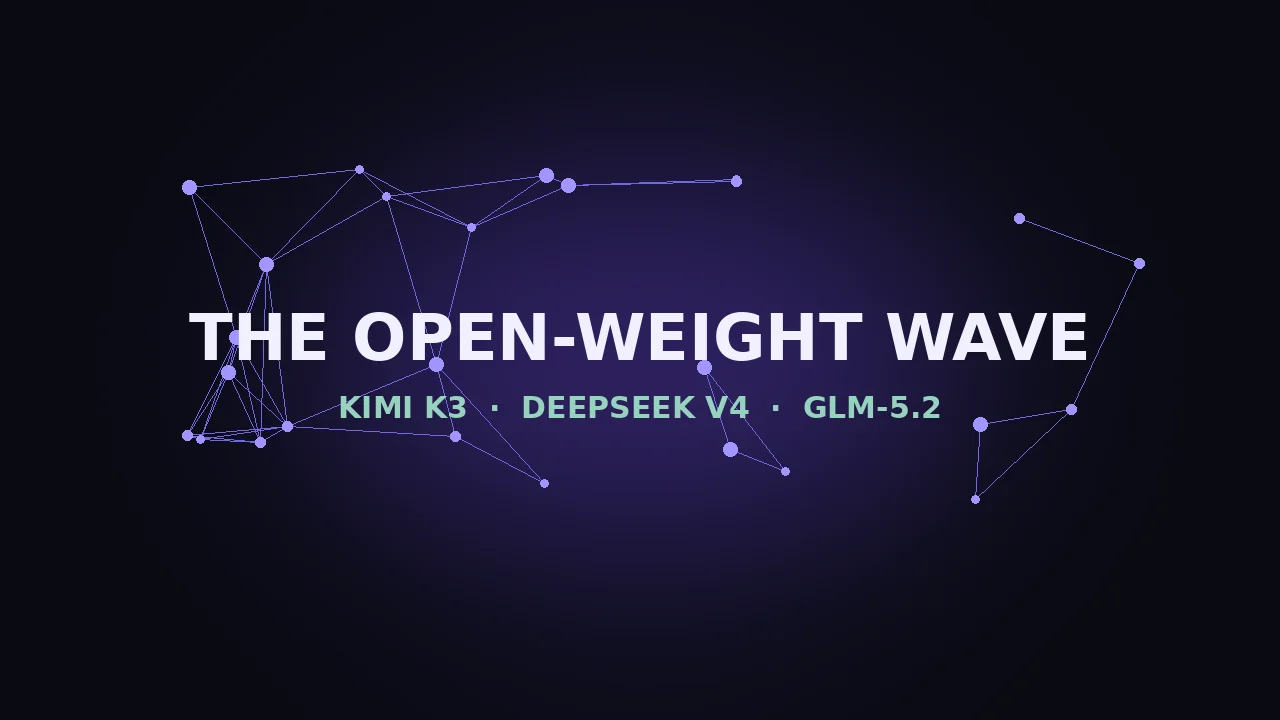
Something structural is shifting in AI, and it isn't happening inside the closed labs. In the span of a few weeks: Moonshot AI shipped Kimi K3 on July 16 — a sparse mixture-of-experts model with a one-million-token context window built for coding and agent tasks — and committed to publishing its weights by July 27 under a Modified MIT license. DeepSeek's V4 line, open since spring, anchors the field with V4-Pro: 1.6 trillion total parameters with 49 billion active, MIT-licensed on Hugging Face. Zhipu's GLM-5.2 rounds out a trio of open trillion-scale MoE models that independent outlets are now comparing head-to-head on benchmarks, licensing, and serving cost — a comparison that would have been unthinkable at this scale a year ago.
Even the housekeeping signals maturity: today, July 24, DeepSeek retires its legacy chat and reasoner API endpoints — three days before K3's weights land. The open-weight ecosystem now moves with the cadence of a commercial platform, deprecation schedules and all.
What "Open" Buys You at a Trillion Parameters
The practical case for these models is cost and control. Sparse MoE architectures mean a 1.6-trillion-parameter model activates only a few percent of its weights per token — so serving costs land closer to a mid-size dense model while benchmark performance approaches frontier territory on coding and agentic tasks. For enterprises wary of API dependency, per-token pricing, and data governance, a genuinely capable MIT-licensed model that runs on their own infrastructure is not an ideological preference. It's a procurement decision.
The gap that remains is at the very top: the closed frontier — GPT-5.6, Fable 5, whatever Gemini 3.5 Pro turns out to be — still leads on the hardest reasoning. But the distance keeps shrinking, and the price difference doesn't.
The Political Storm Overhead
The wave has company. A White House science office official has reportedly accused Moonshot of building K3 in part by distilling Anthropic's Fable model — characterizing it as large-scale covert extraction of US technology. The allegation, which Moonshot has not conceded and which echoes Anthropic's own distillation accusations against Alibaba's Qwen lab earlier this summer, reframes open-weight releases from Chinese labs as a national-security question rather than a licensing one.
That framing matters for what comes next. If Washington moves from statements to restrictions — on model releases, hosting, or the compute behind them — the open-weight ecosystem could bifurcate along geopolitical lines just as it reaches technical parity. The K3 weights drop on July 27 is suddenly about much more than benchmarks.
What to Watch
Three markers over the next month: whether K3's published weights reproduce its API benchmarks (past releases from several labs have shipped weights slightly behind their hosted versions); whether US cloud providers host the weights or quietly decline; and whether the distillation dispute produces evidence, litigation, or policy. The open-weight wave is real either way — the question is whose shores it's allowed to reach.
















































Commenting is currently unavailable on this article.