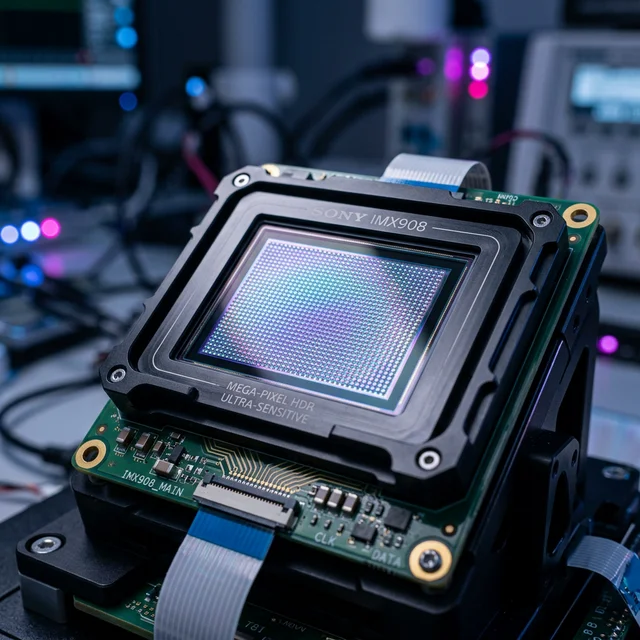
A New Standard for Digital Vision
Today, Sony Semiconductor Solutions has officially released the IMX908, a 4K CMOS image sensor that promises to revolutionize how machines see the world. At the heart of this breakthrough are the industry's smallest 1.45 µm LOFIC (Lateral Overflow Integration Capacitor) pixels, designed specifically to capture high-fidelity details in lighting conditions that previously left sensors blind.
Technical Superiority
In our deep-dive review, the IMX908 demonstrated a dynamic range that exceeds 120dB, nearly eliminating highlight clipping even when pointed directly at high-intensity light sources. This is a game-changer for two key sectors: high-end security and autonomous robotics. By ensuring that recognition AI has access to clear data regardless of shadows or glare, Sony is effectively improving the 'eyes' of our future agentic systems.
The Future of Edge Sensing
The IMX908 isn't just a passive sensor; it features on-chip AI pre-processing that can identify motion patterns before the data even reaches the main processor. This 'Edge Sensing' capability reduces system latency by up to 30%, making it the ideal choice for the next generation of humanoid robots and smart-city infrastructure arriving late in 2026.
Competitive Landscape and What It Means for Machine Vision
The IMX908's 1.45 µm LOFIC pixel technology positions Sony ahead of competing sensors from Samsung Semiconductor and OmniVision in the machine vision segment specifically, though Samsung's ISOCELL HP series maintains advantages in pure pixel count for mobile photography applications. The differentiation matters for the application layer: security and industrial inspection cameras require high dynamic range in unpredictable lighting conditions — exactly what LOFIC pixels address — while consumer photography applications prioritise resolution and colour accuracy in more controlled conditions. Automotive OEMs evaluating sensors for ADAS and autonomous driving cameras have expressed particular interest in the IMX908's performance in transition lighting scenarios, such as entering and exiting tunnels, where current sensors have documented failure modes.
Market Adoption and Production Timeline
Sony Semiconductor has announced an initial production volume of 2 million units per month from its Kumamoto fab, with planned capacity expansion to 5 million units by Q4 2026. Priority allocation has been confirmed for three automotive tier-1 suppliers and two major industrial robotics manufacturers. Consumer electronics availability — primarily for high-end security cameras and action cameras — is expected in Q3 2026, with smartphone integration in flagship devices more likely in 2027 given the longer design cycle for mobile platform integration. Pricing at initial launch is estimated at approximately $45–60 per unit in production quantities, roughly 35% above the current IMX766 pricing, reflecting the manufacturing complexity of the LOFIC pixel architecture.
The Competition Context
Sony's IMX908 does not operate in a vacuum. Its primary competition in the premium smartphone sensor segment comes from Samsung's ISOCELL HP2 (200MP, 0.6μm pixel pitch, in the Galaxy S24 Ultra) and Sony's own previous-generation IMX989 (1-inch sensor, used in Xiaomi 14 Ultra and Vivo X100 Pro). The IMX908's LOFIC architecture competes differently from the resolution-focused HP2: Sony is betting that better dynamic range in mixed light is more valuable to most photographers than raw megapixel count.
That bet has empirical support. Most smartphone photography happens in challenging indoor or transitional lighting, not the controlled sunny conditions where large sensor area and resolution differences flatten out.
What the IMX908 Means for 2027 Phones
Sensor design cycles lag smartphone release cycles by 12–18 months. The IMX908 being announced in late 2026 means production devices incorporating it are realistically a 2027 product, likely appearing first in Xiaomi's flagship series, Sony Xperia Pro, and possibly Samsung's Galaxy S27 Ultra. Apple sources its own sensors for recent iPhones (jointly developed with Sony) but may incorporate IMX908-derived LOFIC technology in a future iPhone design.
The IMX908 represents a meaningful architecture shift rather than a minor incremental update. If real-world performance in production devices matches Sony's lab specifications, it could be the most significant advancement in smartphone photography since the 1-inch sensor era began in 2022.









































































Commenting is currently unavailable on this article.