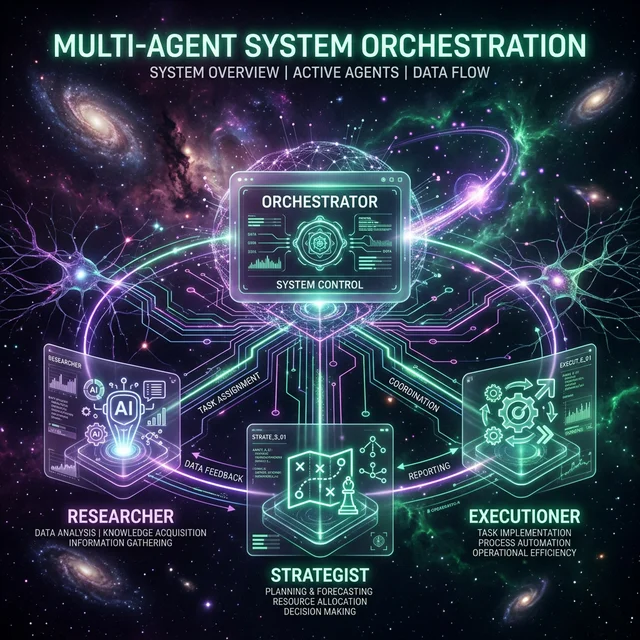
The Shift to Autonomy
As of March 16, 2026, the technology landscape is witnessing a fundamental shift in how artificial intelligence is deployed within the enterprise. We are moving past the era of singular chatbots and into the age of Agentic AI—ecosystems of specialized agents that work together to accomplish massive objectives with minimal human oversight.
Collaborative Intelligence
Unlike traditional AI which requires constant prompting, these new systems use 'Agentic Workflows' to decompose complex tasks into sub-goals. One agent might handle research, another handles data synthesis, while a third manages project execution. This multi-agent approach is delivering productivity gains of up to 40% in sectors like software development, legal research, and supply chain management.
Ethical Governance and Oversight
With increased autonomy comes a heightened focus on AI safety and governance. Premium platforms are now integrating real-time 'Human-in-the-Loop' (HITL) triggers for critical decision points, ensuring that while the heavy lifting is handled by agents, the strategic oversight remains firmly in human hands. This balance is becoming the new standard for Responsible AI in 2026.
The Technical Architecture of Multi-Agent Systems
At a technical level, the agentic AI systems gaining traction in 2026 share a common architectural pattern: a planning or orchestration agent decomposes a high-level objective into sub-tasks, routes those tasks to specialised worker agents with appropriate tools and permissions, and synthesises their outputs into a coherent result. The key enabling infrastructure that makes this practical at enterprise scale includes reliable tool use APIs (function calling), structured memory systems that persist context across agent interactions, and evaluation frameworks that can detect when an agent has produced an unreliable output requiring human review. Without the evaluation layer, agentic systems in production tend to fail silently — producing confident but incorrect outputs that downstream processes treat as authoritative.
Real-World Deployments and What They Reveal
The most successful agentic deployments to date share a common characteristic: they are applied to processes with clear, verifiable outputs rather than open-ended reasoning tasks. Contract review, code generation with test suite validation, customer support ticket triage, and financial report generation are all areas where the correctness of the output can be objectively checked — which means errors can be caught and the system can be iteratively improved. Deployments in less verifiable domains, including strategic planning support, creative content generation, and nuanced legal analysis, have shown higher rates of subtle errors that pass review precisely because the domain is complex enough that human reviewers trust the AI output rather than checking it rigorously.
Where Multi-Agent Systems Are Being Deployed Today
The transition from single-agent to multi-agent AI has moved from research to production in several enterprise contexts:
Code review pipelines — Microsoft's GitHub Copilot Workspace uses a multi-agent architecture where a planning agent breaks a feature request into tasks, coding agents implement each component, and a review agent checks for consistency and errors before presenting changes to the human developer.
Customer support — Enterprises running AI customer support are increasingly using triage agents (classify the issue), resolution agents (attempt to solve it with existing knowledge), and escalation agents (determine when to transfer to a human and provide context) in a coordinated pipeline.
Financial research — Hedge funds and investment banks are deploying multi-agent research systems where a market data agent fetches current prices and earnings, a news agent monitors recent developments, a quant agent runs statistical models, and a synthesis agent produces a structured report for analyst review.
The Coordination Problem
The central technical challenge in multi-agent systems is not any individual agent's capability but the reliability of inter-agent communication. When Agent A passes a task to Agent B, Agent B needs to understand not just the task itself but the context in which it was requested, the constraints Agent A was operating under, and the expected output format. Current frameworks handle this through structured handoff protocols, but the failure modes — agents misinterpreting context, duplicating work, or producing outputs that don't compose correctly — remain common enough to require human monitoring in production deployments.
OpenAI's research on agentic systems has found that multi-agent systems fail more often on task coordination than on individual capability. Improving the reliability of agent-to-agent communication is one of the most active areas of AI systems research in 2026.




























































Commenting is currently unavailable on this article.