
Moving Beyond the Chatbot
In 2026, building a successful AI startup isn't about having the best prompt; it's about having the best Orchestration. If you're a founder looking to capitalize on the 'Agentic Era,' your first step is moving from single-agent interactions to multi-agent workflows. This guide breaks down how to design a system where specialized agents cooperate to solve complex business problems.
Step 1: Decompose the Complexity
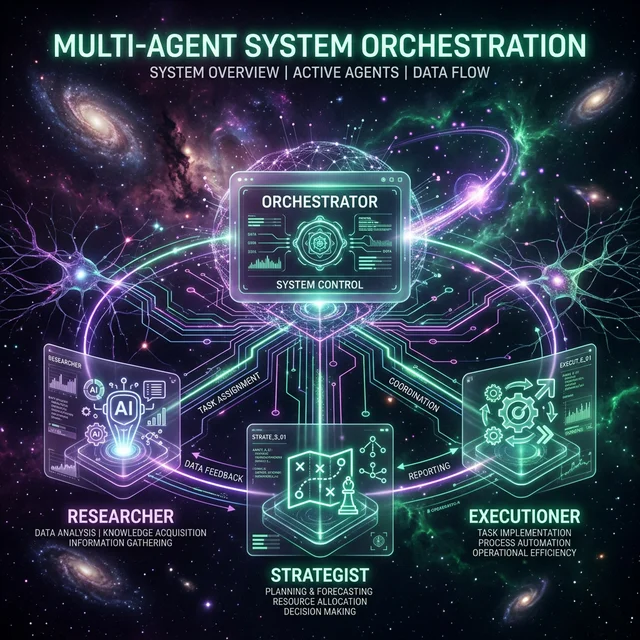
Start by taking a high-value workflow—such as competitive market analysis—and breaking it into sub-tasks. You don't ask one AI to do the whole job. Instead, you design a 'Researcher Agent' to gather data, a 'Strategist Agent' to identify patterns, and a 'Report Agent' to synthesize the output. This hierarchical approach reduces errors and allows each agent to use specialized tools.
Step 2: Establish Governance
Autonomy without oversight is a liability. Your architecture must include 'Approval Checkpoints.' In 2026, the best frameworks are 'Human-in-the-Loop' (HITL), where the agents autonomously handle 90% of the heavy lifting but stop and request human verification before making high-stakes decisions or executing financial transactions. By identifying these 'Trust Zones,' you can scale with confidence using today's modern agentic platforms.
Common Pitfalls to Avoid
The most common failure mode in early multi-agent architectures is what practitioners call "agent sprawl" — deploying more specialised agents than the orchestration layer can reliably coordinate, resulting in redundant work, conflicting instructions, and outputs that are harder to debug than a single-agent system would have been. A pragmatic rule of thumb is to start with three to five agents maximum, validate that coordination works reliably before adding more, and only add specialisation where you can clearly measure the performance gain. The second most common failure is inadequate context management: agents that don't share a common, structured understanding of task state will produce inconsistent outputs and require expensive re-runs. Using a structured shared memory store — a database or message queue rather than passing context through the primary model's context window — is the architecture pattern that separates production-grade systems from prototypes.
Security and Reliability Considerations
Multi-agent systems that interact with external APIs, databases, or code execution environments introduce attack surfaces that single-agent systems don't have. Prompt injection — where malicious content in data retrieved by one agent attempts to redirect other agents' behaviour — is the most significant security risk and requires explicit sanitisation at every inter-agent handoff. Rate limiting and circuit breakers should be implemented at the orchestration layer to prevent a misbehaving agent from exhausting API quotas or triggering runaway spending on inference costs. For production systems handling sensitive data, each agent should operate with the minimum permissions required for its specific task, following the same least-privilege principle that applies to human service accounts.

































































Commenting is currently unavailable on this article.