
The Core Problem AI Is Solving
Drug discovery has always faced the same brutal mathematics: the human body contains approximately 20,000 proteins, each of which can interact with thousands of potential drug molecules in complex and often unpredictable ways. Finding a molecule that binds to the right protein, at the right site, with the right specificity — without binding to the wrong proteins and causing side effects — is an enormously expensive search problem.
Traditional drug discovery handles this through experimental screening: researchers synthesise or acquire libraries of hundreds of thousands of compounds and test them against a target protein in the lab, looking for "hits" that show binding activity. This process is reliable but slow and expensive. Running a high-throughput screening campaign typically costs $1–5 million and takes 6–18 months, and it still only finds leads — not drugs. Optimising a lead compound into something safe and effective enough for clinical trials takes years more.
AI changes the economics of this search problem. Machine learning models trained on existing experimental data can predict which molecules are likely to bind to a target, rank them by predicted efficacy and safety, and guide chemists toward the most promising candidates — drastically reducing the number of compounds that need to be synthesised and tested in the lab.
The Breakthrough That Changed Everything: AlphaFold
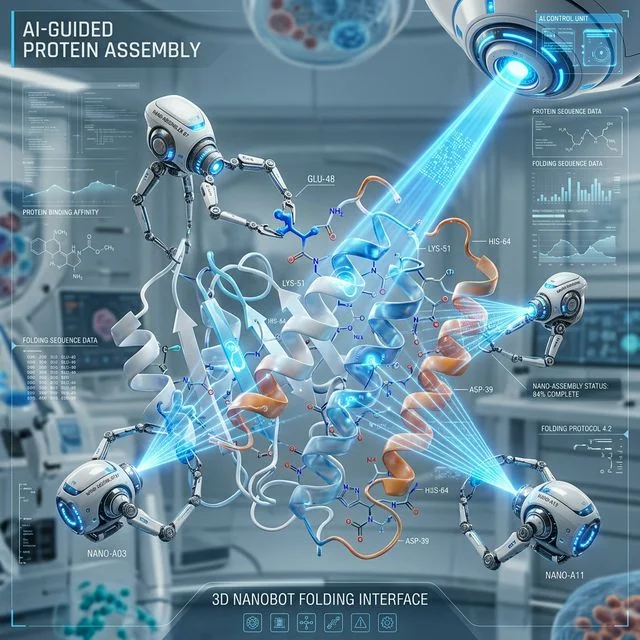
In 2020, Google DeepMind's AlphaFold system achieved a landmark result in computational biology: it could predict, with near-experimental accuracy, the three-dimensional structure of a protein from its amino acid sequence alone. This is significant because a drug's ability to bind to a protein depends critically on the protein's shape — specifically, the geometry of the binding site.
Before AlphaFold, determining a protein's structure required X-ray crystallography or cryo-electron microscopy — expensive, time-consuming laboratory techniques. AlphaFold made structure prediction fast and cheap. DeepMind released a database of predicted structures for essentially all known human proteins (and hundreds of millions of proteins from other organisms), available for free to researchers worldwide.
AlphaFold 3, released in 2024, extended the capability to predict how proteins interact with small molecules, DNA, RNA, and other proteins — making it directly useful for drug binding prediction, not just structure determination.
The AI Drug Discovery Stack
Modern AI drug discovery involves several layers of technology working together:
Structure prediction — AlphaFold and similar tools predict what a target protein looks like. Without this, you cannot reliably model how drug candidates will bind.
Generative molecular design — AI models (often graph neural networks or transformer models trained on molecular data) can generate novel molecular structures predicted to bind to a given target. Rather than screening existing compound libraries, these models design new candidates from scratch. Insilico Medicine uses this approach; its AI-designed lung fibrosis drug ISM001-055 reached Phase II clinical trials — the first fully AI-designed small molecule drug in human trials.
ADMET prediction — Even a molecule that binds to the right target won't become a drug if it is absorbed poorly, metabolised too quickly, toxic to the liver, or unable to cross the blood-brain barrier. ADMET (Absorption, Distribution, Metabolism, Excretion, Toxicity) prediction models estimate these properties computationally before expensive lab testing.
Phenomics — Recursion Pharmaceuticals takes a different approach: it runs millions of automated biological experiments (measuring how cells look and behave when exposed to different compounds) and trains AI on the resulting image data to understand cellular responses at scale. This generates its own proprietary dataset rather than relying solely on published literature.
Literature and data mining — Large language models trained on scientific text can surface connections across the published literature that human researchers might miss — identifying potential targets, repurposing approved drugs for new indications, and flagging known toxicity patterns for related compounds.
The Leading Players
Google DeepMind / Isomorphic Labs — DeepMind spun out Isomorphic Labs in 2021 specifically to apply AlphaFold to drug discovery. It has partnerships with Eli Lilly (up to $1.7 billion) and Novartis (up to $1.2 billion) for AI-assisted drug design. DeepMind released AlphaFold 3 in 2024, enabling joint protein-ligand structure prediction.
Recursion Pharmaceuticals — A publicly listed company (RXRX) that combines high-throughput biological experiments with machine learning. It acquired Exscientia in 2024, adding clinical-stage AI-designed compounds to its pipeline. As of 2026, Recursion has multiple programs in clinical development.
Insilico Medicine — Has ISM001-055 in Phase II for idiopathic pulmonary fibrosis, making it the leader in getting fully AI-designed drugs into human trials. Based in Hong Kong and New York.
Anthropic Claude Science — Launched June 30, 2026, focuses on the research productivity layer: helping scientists query and synthesise across 60+ scientific databases rather than competing directly with structure prediction or molecular generation platforms.
Schrödinger — A computational chemistry company that has been predicting molecular behaviour for over 30 years and has adapted its physics-based simulation platform to incorporate machine learning, bridging classical computational chemistry and AI.
What the Timeline Looks Like Now
Traditional drug discovery: 15 years from target identification to approval, $2 billion average total cost, fewer than 10% of clinical candidates succeeding in Phase III.
With AI-augmented discovery, estimates for programs well-suited to AI tools suggest: 4–6 years from target to clinic entry (not approval), with significantly lower early-stage costs. Clinical success rates are still unclear — not enough AI-designed drugs have completed trials to establish a statistical track record.
The caveat is important: AI primarily compresses the pre-clinical discovery and optimisation phase. Clinical trials themselves — which account for most of the cost and time in drug development — are not yet significantly accelerated. Patients still need to be enrolled, treated, and observed over years. No AI system can compress that biology.
What Is Still Hard
Despite the progress, several problems remain genuinely difficult:
Predicting clinical failure — Most drugs fail in clinical trials because of toxicity, lack of efficacy in humans (despite promising animal models), or off-target effects that weren't predicted. AI is getting better at flagging these risks but cannot yet reliably predict clinical success.
Rare diseases — AI works best when it has abundant training data. For rare diseases affecting fewer than 200,000 patients, data is limited. This is exactly the patient population with the highest unmet medical need.
Biologics — Most AI drug discovery tools work best for small molecule drugs. Antibodies, gene therapies, and cell therapies involve different design challenges that current tools address less completely.
Regulatory acceptance — Drug regulators (FDA, EMA) are still developing frameworks for evaluating AI-designed drugs. How much weight can an AI model's prediction carry in a regulatory submission? The answer is evolving in real time.
The Bottom Line
AI has made drug discovery measurably faster and cheaper at the early pre-clinical stage. The protein structure prediction problem — once considered one of biology's great unsolved challenges — is essentially solved. Generative molecular design is moving from proof-of-concept to real clinical programs. The frontier question is now about clinical translation: do AI-designed drugs actually perform better in humans than conventionally discovered ones? The first wave of clinical data from fully AI-designed compounds will answer that question definitively — and the answers should start arriving in the next two to three years.
























































Commenting is currently unavailable on this article.