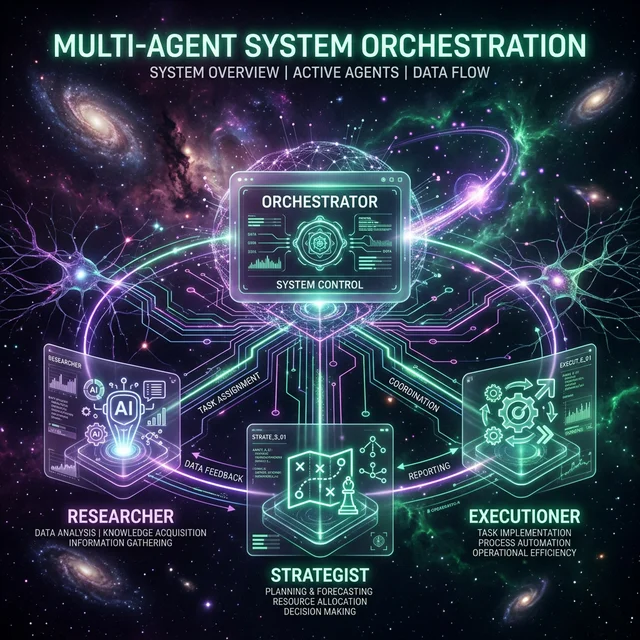
From Answering to Acting
For most of the last few years, the headline AI product was a chat window: you typed a question, a model answered. Through the first half of 2026, the center of gravity has shifted toward "agentic" AI — systems that take a goal, break it into steps, use tools and browsers on their own, and report back once the task is actually done, not just described.
What's Actually Changed
Three things have converged to make this practical rather than theoretical. Model providers have made tool-calling and multi-step planning dramatically more reliable, reducing the silent failure modes that made early agent demos look impressive but unusable. Browser and OS-level automation hooks have matured, letting agents click, fill forms, and navigate real interfaces rather than only calling clean APIs. And enterprises have built guardrail layers — approval steps, audit logs, spending limits — that make handing real tasks to an agent less of a leap of faith.
Where It's Working
The clearest wins are narrow and repetitive: triaging support tickets, reconciling expense reports, drafting and scheduling routine communications, and research tasks that involve checking many sources and summarizing findings. These are jobs with low stakes per failure and clear success criteria, which is exactly the profile agentic AI handles best today.
Where It Still Breaks
Longer-horizon tasks with ambiguous goals remain a weak point — agents can wander, misinterpret intent, or quietly take a wrong turn several steps before a human notices. Security teams are also flagging a new class of risk: prompt injection through the content an agent reads while completing a task, where malicious instructions hidden in a webpage or document can hijack an otherwise well-behaved agent.
The Practical Takeaway
Treat agentic AI the way you'd treat a capable but unsupervised new hire: well-suited to bounded, well-defined work with a human checkpoint at the end, not yet ready to be handed open-ended judgment calls. That balance is likely to shift over the next year as guardrails and reliability both improve, but it hasn't shifted all the way yet.
What "Doing" Looks Like in Practice
The clearest examples of the shift from chat to task execution are in software development workflows. GitHub's Copilot Workspace (launched 2025) allows a developer to describe a feature in plain language; the system then browses the codebase, plans the implementation, writes code changes across multiple files, runs the test suite, interprets failures, and revises until tests pass — before presenting the complete set of changes for human review. The human never writes code in this flow; they specify intent, review output, and approve or modify.
A similar pattern is emerging in knowledge work. OpenAI's Deep Research product (2025) produces multi-hour autonomous research sessions: the system plans a research strategy, executes dozens of web searches, reads sources, synthesises findings across sources, and produces a structured report with citations. The human's role is limited to specifying the research question and reviewing the output.
Where the Reliability Floor Currently Is
Production deployments consistently report that current agentic systems perform reliably on tasks meeting three criteria: the task is well-defined, the success criteria are verifiable (the agent can determine when it's done), and the task doesn't require judgment calls that depend on unstated context. Tasks outside these boundaries — especially those requiring domain expertise the agent wasn't trained on, or those where success is subjectively defined — fail at rates too high for unsupervised deployment.
Several large enterprise deployments have reported that the most valuable agentic configurations are those with a human checkpoint after each major phase of work, not at the end of the entire task. This "human-on-the-loop" design captures most of the efficiency benefit while catching failures before they compound into hard-to-reverse errors — a design pattern increasingly treated as standard practice in enterprise agentic deployments.





























































Commenting is currently unavailable on this article.