
The Problem One Agent Couldn't Solve
A single AI agent that researches a topic, drafts a document, and checks its own work can only get so far before the task is bigger than one workflow. Through 2026, more organizations have started deploying several specialized agents at once — a researcher, a writer, a reviewer, a scheduler — and quickly run into a coordination problem: who decides what happens next, and what happens when two agents disagree.
Enter the Orchestrator
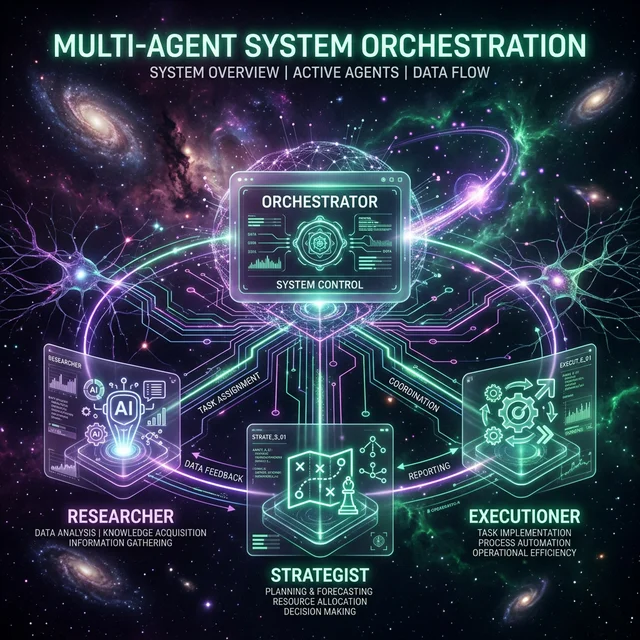
A new tier of "orchestration" platforms has emerged specifically to manage this. These systems sit above individual agents, routing tasks to the right specialist, tracking shared state so agents aren't duplicating or contradicting each other's work, and enforcing rules about which agent has final say. Several vendors now describe their product not as "an AI agent" but as "an agent operating system" — a meaningful shift in how the category is being marketed and sold.
Why This Matters for Reliability
Independent agents working in isolation tend to fail in compounding ways: one agent's small misunderstanding becomes the next agent's wrong assumption. Orchestration layers add checkpoints between handoffs, which has measurably reduced these cascading errors in early enterprise deployments, according to vendors and the analysts tracking this space.
The Cost Side of the Equation
Running several coordinated agents instead of one model call is meaningfully more expensive, and orchestration platforms add their own overhead. Teams adopting this pattern are having to get much more disciplined about which tasks actually need multi-agent coordination versus which would be handled just as well — and much more cheaply — by a single well-prompted model call.
What to Watch
Expect consolidation: this is a crowded space with significant overlapping functionality between startups and the orchestration features being added directly into the major model providers' own platforms. The standalone vendors that survive will likely be the ones solving a specific coordination problem — compliance auditing, cross-team handoffs — rather than general-purpose orchestration.
The Vendor Landscape
The multi-agent orchestration market has fragmented into three tiers in 2026:
Framework layer (open source) — LangGraph (from LangChain), Microsoft's AutoGen, and CrewAI are the leading open-source frameworks for building multi-agent systems. LangGraph is particularly strong for production deployments because it treats agent state as a first-class concept — each agent in the graph has a defined state, and transitions between agents are explicit. AutoGen is more flexible for research-style multi-agent experiments. CrewAI focuses on readability and ease of configuration for non-ML engineers.
Model provider platforms — OpenAI's Assistants API, Anthropic's Claude Agent SDK, and Google's Vertex AI Agent Builder each provide hosted multi-agent capabilities built atop their own models. These are easier to get started with but lock compute to a single model provider and offer less flexibility than open-source frameworks.
Enterprise orchestration platforms — Salesforce Agentforce, ServiceNow AI Agents, and Microsoft Copilot Studio operate at the business-workflow layer, providing pre-built agent templates for specific enterprise use cases (CRM, IT support, HR) with connectors to existing enterprise software. These target business users rather than developers and command premium pricing.
The Pricing Dynamic
Open-source framework adoption is strong, but enterprises running production agentic workflows typically pay for the underlying model inference (priced per token by OpenAI, Anthropic, or Google), the orchestration hosting (if using managed infrastructure), and the operational tools (monitoring, logging, guardrails). Total cost of ownership for a production agentic workflow is often $0.20–$5.00 per completed task, depending on complexity and model choice — a figure that makes careful cost analysis essential before scaling.
The Consolidation Ahead: The multi-agent orchestration market is likely to consolidate significantly over the next 12–18 months as model providers (OpenAI, Anthropic, Google) expand their native orchestration capabilities. Standalone orchestration vendors will need to demonstrate clear advantages in specific verticals — security auditing, regulated industry compliance, cross-cloud portability — to maintain independent positioning once the platform layer matures.
















































Commenting is currently unavailable on this article.