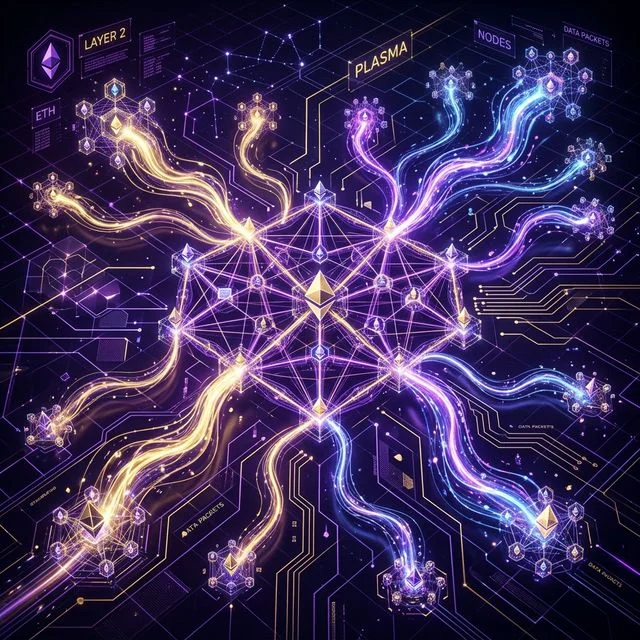
A Scaling Idea From Ethereum's Early Years
Plasma was one of Ethereum's first serious proposed solutions to its scaling problem, originally outlined years before today's rollup-centric roadmap became the dominant approach. It fell out of mainstream development focus as rollups proved easier to build and reason about, but it never fully disappeared from research circles — and in 2026, it's seeing a genuine resurgence of development activity.
Why It's Coming Back Now
The renewed interest is driven less by nostalgia than by specific limitations current rollup designs run into for certain use cases, particularly high-throughput, low-value-per-transaction applications like gaming and micropayments, where rollup data costs still add up at scale. Plasma's design, which keeps most transaction data off the main chain entirely while preserving strong security guarantees through fraud proofs, looks attractive again for exactly those workloads.
The Trade-Offs That Haven't Changed
Plasma's core limitation is the same one that pushed developers toward rollups originally: it handles simple token transfers well but struggles with the complex smart contract interactions that power most of today's DeFi applications. The renewed development work is explicitly scoped to use cases that fit this constraint, not a wholesale replacement for rollups.
Who's Actually Building With It
The current wave of Plasma-based projects is concentrated in gaming infrastructure and payment-focused applications rather than general-purpose DeFi protocols — a sign that this is a targeted revival for a specific niche rather than a fundamental shift in Ethereum's broader scaling roadmap.
The Bigger Pattern
This is a useful reminder that blockchain scaling isn't a solved, linear progression toward one best answer — different transaction patterns genuinely benefit from different architectures, and ideas considered "superseded" can become relevant again as the ecosystem's needs diversify.
What Plasma Originally Was
Plasma was proposed by Ethereum co-founder Vitalik Buterin and Lightning Network creator Joseph Poon in a 2017 white paper as a Layer 2 scaling solution. The core idea: create child chains anchored to Ethereum's main chain, with the main chain serving as a dispute resolution mechanism. Transactions happen on the child chain (fast and cheap) and the main chain provides a security guarantee that users can always exit to with their funds intact.
Plasma's problems in practice were primarily around user experience: the "exit game" required users to monitor the child chain and submit fraud proofs if operators misbehaved. If a user went offline during a mass exit event, they could lose funds. This data availability problem led most developers to abandon Plasma in favour of Optimistic Rollups and ZK-Rollups, which solved the security guarantee differently (by posting all transaction data to Ethereum main chain, making exits simple).
Why It's Back in Conversation
Two developments have renewed interest in Plasma architectures. First, improved ZK-proof efficiency has made it feasible to construct Plasma-style systems with cryptographic security guarantees that don't require users to monitor the chain — the exit game problem can be made trustless rather than requiring user vigilance. Second, specific use cases (particularly gaming and low-value payment applications) have made the data-availability trade-off more acceptable: for a game where transactions represent in-game actions rather than high-value financial transfers, the simplicity and cost advantage of Plasma-style architectures may justify the additional complexity.
Polygon has maintained Plasma support alongside its main PoS chain and ZK-EVM stack. Immutable X (focused on NFT gaming) used a Validium architecture (a Plasma variant with ZK proofs) as its core technology. The category is not dead — it is being applied selectively where the trade-offs make sense.
The Practical Assessment: For developers choosing a Layer 2 architecture in 2026, Plasma remains a niche choice. Optimistic Rollups (Optimism, Arbitrum) and ZK-Rollups (zkSync, Starknet, Polygon zkEVM) have more developer tooling, larger ecosystems, and clearer paths to Ethereum equivalence. Plasma's revival is most relevant for specific narrow applications (gaming, micropayments, IoT) where its specific trade-offs make sense — not as a general-purpose alternative to the dominant rollup approaches.

















































Commenting is currently unavailable on this article.