
The Numbers
Bitcoin traded around $59,334 in late June 2026, its lowest level since October 2024 and a roughly 52% decline from its October 2025 all-time high near $126,210. The decline hasn't been a single sharp crash so much as a grinding slide punctuated by sharper drops, including a single-session fall of about 15% back in early February that first pushed the price toward the $60,000 level.
What's Actually Behind the Selloff
Unlike some past crypto downturns driven by retail panic, analysts tracking this slide point to institutional flows as the primary driver. US spot Bitcoin ETF data has shown consistent net outflows since late April, totalling roughly $4.2 billion through mid-June. The largest outflows came from Grayscale's Bitcoin Trust (GBTC, now converted to an ETF) and several smaller ETF products; BlackRock's iShares Bitcoin Trust (IBIT) has shown smaller but still negative net flows in the same period.
The ETF dynamic matters because it inverts the retail panic narrative. When institutional investors holding ETFs are net sellers, the price impact is more persistent and harder to reverse with a single sentiment shift. These investors require macro catalysts to reverse positioning — they don't buy on dips because "number go up."
What the CLARITY Act Is
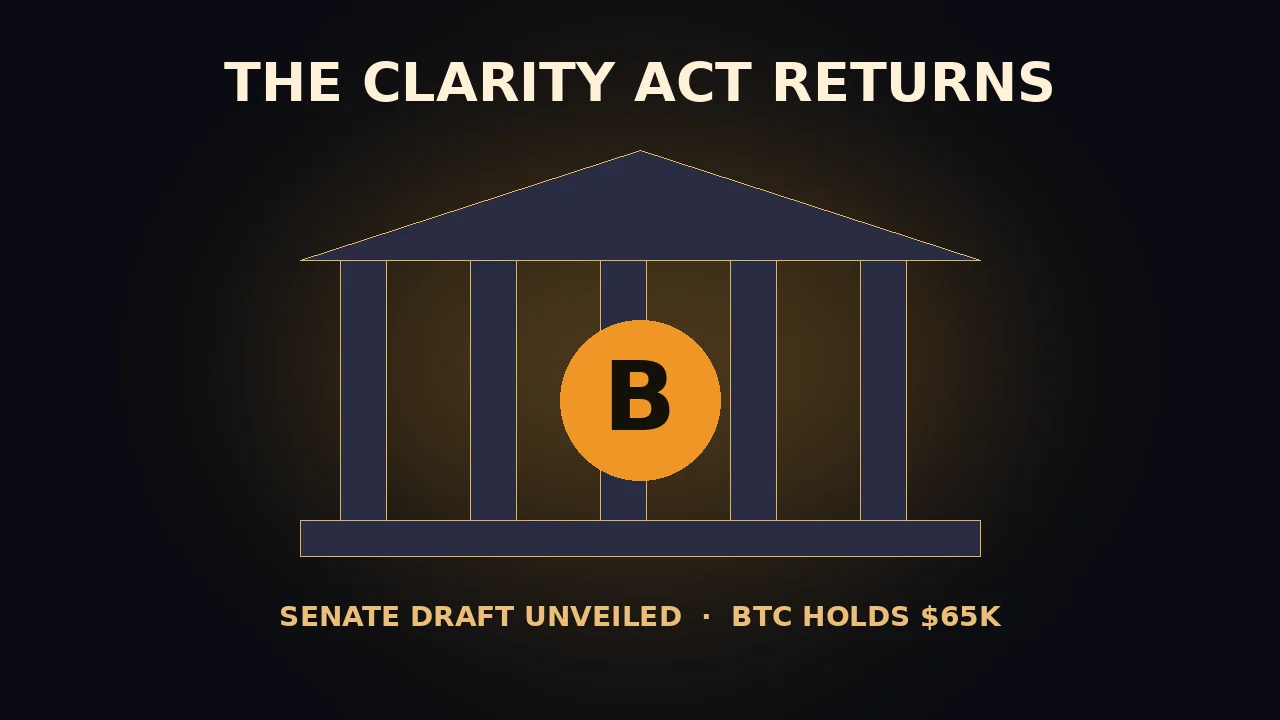
The Crypto, Labor, and Innovation of the Future Act — known by its acronym CLARITY — is the most significant piece of US crypto legislation in several years and the primary source of market uncertainty heading into the June selloff.
CLARITY's core provision is a framework for classifying digital assets as either "digital commodities" or "digital securities." This matters enormously for the industry because it determines which regulator — the CFTC or the SEC — has jurisdiction over each asset. Crypto firms have spent years arguing that their tokens are commodities (CFTC jurisdiction, lighter regulatory touch) while the SEC has argued most tokens are unregistered securities.
CLARITY's proposed framework would classify Bitcoin and Ethereum unambiguously as commodities. For most other tokens, it sets out a set of criteria — decentralisation thresholds, revenue-sharing characteristics, governance structures — for making the determination.
The bill passed the House in May 2026 with bipartisan support. It then stalled in the Senate, where disagreements about the decentralisation criteria and SEC oversight provisions delayed floor consideration. Markets interpreted the stall as regulatory uncertainty extending into late 2026 at minimum.
Why Regulatory Clarity Matters to Price
This seems counterintuitive at first — shouldn't crypto want less regulation? The answer for institutional investors is no. Fund managers at major asset management firms can only deploy capital into assets that have a clear, legally predictable regulatory status. While a Bitcoin ETF already solves this for Bitcoin itself, the CLARITY Act would unlock institutional capital for a much broader range of crypto assets and DeFi protocols. The delay of CLARITY is being read as a delay in that capital deployment.
Historical Context: How Long Do Bitcoin Bear Markets Last?
The 2026 bear market is the fourth significant Bitcoin drawdown since the 2017 cycle. Previous post-ATH drawdowns have lasted:
- 2018 crash: Bitcoin fell 84% from ATH; recovery to new ATH took approximately 3 years
- 2021–2022 crash: Bitcoin fell 77%; recovery took approximately 2 years
- 2022–2023 post-FTX collapse: Bitcoin fell roughly 65%; recovery to new ATH took 14 months
The current drawdown of roughly 52% from ATH is shallower than any previous major cycle — which some analysts interpret as a sign of a more mature market with stronger institutional support floors. The 14-month recovery after the FTX collapse is the closest historical analogue for the current environment.
What the Market Is Watching
The most immediate catalyst for the next directional move in Bitcoin is the Federal Reserve's rate path. Bitcoin's 2025–2026 trajectory has been unusually correlated to rate expectations. The June jobs print (released July 5) showed significantly weaker employment than expected, raising the probability of a September rate cut and triggering the recovery bounce that preceded the $64K move in early July.
If the CLARITY Act advances in the Senate — whether through a floor vote or committee compromise before the August recess — markets would likely read that positively regardless of the specific legislative outcome, because clarity itself is the desired signal.
The two factors in combination (a Fed pivot and regulatory clarity) represent the bull case for a Bitcoin recovery. The bear case is a re-acceleration of inflation that delays rate cuts and a continued stalemate on Capitol Hill.
The Bottom Line
The June 2026 Bitcoin selloff is best understood as an institutional repricing event triggered by two intersecting macro and regulatory uncertainties — a delayed Fed pivot and stalled legislative clarity. Neither is permanent. But both need resolution before institutional capital returns to the allocation mode that drove Bitcoin's October 2025 highs. The CLARITY Act's path through the Senate and the Federal Reserve's response to weakening employment data are now the two variables that matter most for Bitcoin's trajectory into the second half of 2026.
Key Data Points
Bitcoin price at time of writing: approximately $59,334. Year-to-date decline from January 1 ($84,200): -29.6%. Decline from October 2025 all-time high ($126,210): -53%. US spot Bitcoin ETF net outflows, May–June 2026: approximately $4.2 billion. CLARITY Act House vote: passed with bipartisan majority, May 2026. Senate status: stalled in committee, June 2026. Fed September rate cut probability (as of July 5 jobs report): 79%.









































































Commenting is currently unavailable on this article.