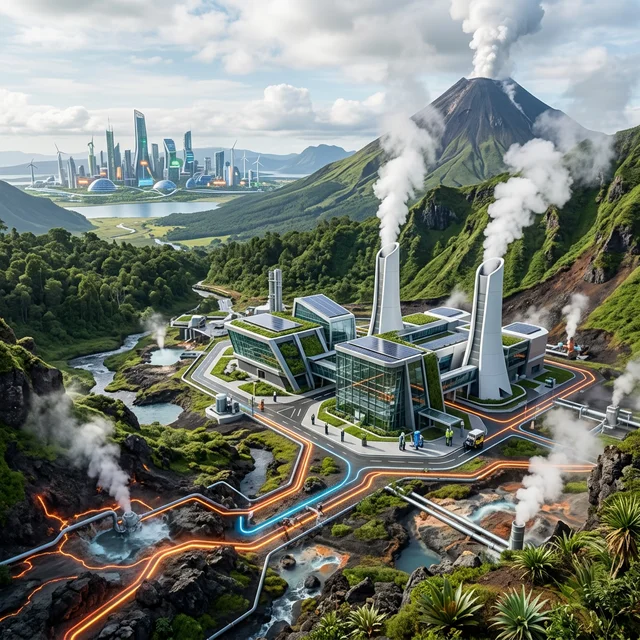
Drilling Deep for Clean Power
The energy demands of 2026 are unprecedented, driven largely by the exponential growth of generative AI training clusters. To meet this need without compromising climate goals, the energy sector has turned to a reliable, ancient source: the heat beneath our feet.
Enhanced Geothermal Systems (EGS)
Traditional geothermal power was limited to specific volcanic regions. However, new Enhanced Geothermal Systems (EGS) utilize advanced fracking and horizontal drilling techniques to tap into hot rock layers anywhere on Earth. This provides a 'Baseload' power source—unlike solar or wind, geothermal runs 24/7, making it the perfect partner for data centers that never sleep.
A Global Transition
Major tech giants are now co-locating their new data centers directly next to geothermal fields in regions previously thought to be energy-poor. This shift is not only stabilizing the grid but also accelerating the global transition away from fossil fuels in industrial-scale power generation.
Key Projects and Investment Scale
The geothermal sector's recent momentum is being driven by a combination of improved drilling technology borrowed from the oil and gas industry — specifically, directional drilling and advanced downhole sensing — and substantial government incentives in the United States under the Inflation Reduction Act's clean energy production tax credits, which apply to geothermal generation on equal terms with wind and solar. The Department of Energy's Enhanced Geothermal Shot initiative has committed $165 million to accelerating EGS cost reductions, targeting a 90% reduction in development costs by 2035. Fervo Energy's Cape Station project in Utah, expected to reach 400 MW of capacity by 2028, and Quaise Energy's millimetre-wave drilling technology, which uses energy beams to vaporise rock and access geothermal resources at depths previously considered impractical, are the two projects receiving the most investor and regulatory attention.
Why Geothermal Suits AI Infrastructure
The specific energy profile of AI data centres — which require consistent, 24/7 power supply rather than the intermittent supply characteristic of solar and wind — makes geothermal an especially attractive pairing. A geothermal plant operates at a capacity factor of 90–95%, meaning it generates near its rated capacity almost continuously, compared with 25–35% for solar and 35–45% for wind in good locations. For hyperscalers and AI companies making decade-long commitments to data centre capacity, the reliability premium of geothermal power commands a meaningful price premium over spot market electricity from variable renewable sources.
The Enhanced Geothermal Breakthrough
Traditional geothermal power requires naturally occurring hydrothermal systems — locations where hot water or steam already exists underground at accessible depths. This limits conventional geothermal to specific geologies (volcanic regions, tectonic boundaries). The United States has roughly 3,000 MW of conventional geothermal installed capacity, concentrated almost entirely in California and Nevada.
Enhanced geothermal systems (EGS) change this constraint fundamentally. EGS involves drilling into hot dry rock anywhere on Earth (which is available within 6–10 km depth essentially everywhere), hydraulically fracturing the rock to create artificial permeability, injecting water to create a closed-loop heat exchange system, and extracting the heated water to generate power. The resource base is essentially unlimited — the US Department of Energy estimates the technically recoverable EGS resource in the United States at over 5,000 GW, compared with total current US electricity generation capacity of approximately 1,200 GW.
Fervo Energy and the Commercialization Timeline
Fervo Energy is the company most directly responsible for the current commercial momentum. Its Cape Station project in Utah — commissioned in 2025 — is the first commercial-scale EGS project in the world, delivering 400 MW of firm power capacity to the grid. The project demonstrated that EGS can be drilled and completed using techniques adapted from the oil and gas industry, dramatically reducing development costs relative to earlier EGS experiments.
Google signed a long-term power purchase agreement with Fervo for a portion of Cape Station's output, making it one of the first major data centre operators powered by commercial EGS. Several other hyperscalers have since signed similar agreements, driving Fervo's project pipeline to over 1,500 MW of planned capacity.
































































Commenting is currently unavailable on this article.