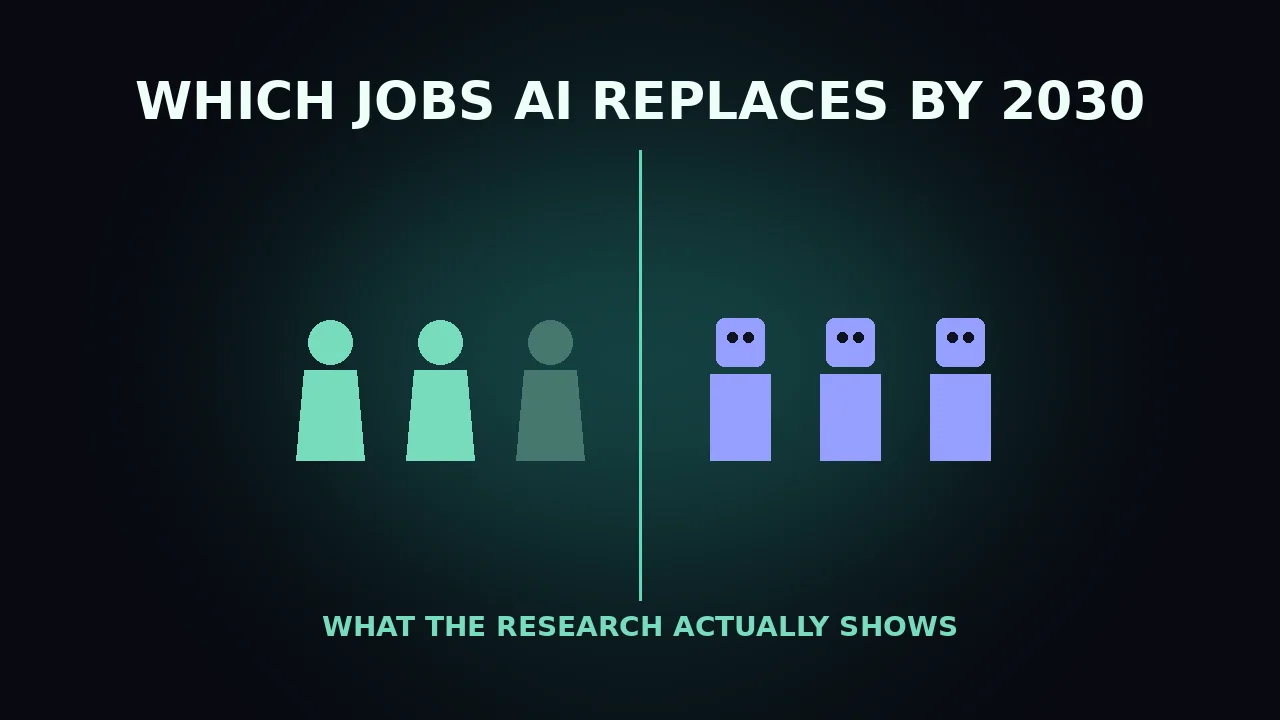
Start With What Can Be Measured
Predictions about AI and employment have a poor track record, mostly because they extrapolate from capability demonstrations rather than from labour data. A model that can write code does not automatically eliminate programmers, any more than spreadsheets eliminated accountants — a profession that grew after their invention.
So this piece works from a narrower question: where has measurable displacement already occurred, and what does that pattern imply for 2030?
The most reliable signal so far comes from Stanford's AI Index work, which found the labour impact concentrated rather than general — a sharp decline in hiring for early-career technology roles, without a corresponding economy-wide collapse in employment. Concentration, not breadth, is the defining feature of the evidence.
The Roles Facing Genuine Displacement
Four characteristics predict real vulnerability: the output is highly structured, the work is fully digital, quality is objectively checkable, and the role exists mainly as a training rung.
Entry-level software development. The clearest case in the data. Tasks that once justified junior hires — boilerplate, simple CRUD features, test scaffolding — are exactly what coding agents do well. Senior engineering demand has not fallen; the ladder's bottom rung has thinned.
Routine content production. Product descriptions, SEO filler, templated marketing copy. Note the qualifier: reported, sourced, or genuinely original writing is not in this category, and readers increasingly distinguish between them.
Tier-one customer support. Scripted, high-volume, resolution-measurable. Displacement here is already well advanced, with escalation to humans remaining the norm for anything unusual.
Routine data processing. Extraction, reconciliation, classification, basic report generation — where accuracy is verifiable and volume is high.
The Much Larger Category: Roles That Change Without Disappearing
Most professional work sits here, and it is where the "will AI take my job" framing misleads most.
Lawyers still practise law; discovery and first-draft contract review are automated. Doctors still diagnose; imaging analysis and documentation are assisted. Analysts still analyse; data gathering and formatting collapse to minutes. Designers still design; iteration cycles compress.
The pattern is consistent: AI absorbs the structured, repetitive portion of a role and leaves the judgement, accountability, and relationship portions — which is often where the value was concentrated anyway. The practical consequence is not unemployment but a rising floor for what counts as competent performance, and pressure on anyone whose value was mainly the automatable part.
Where AI Changes Little by 2030
Three properties confer real durability:
Physical presence and dexterity. Trades, nursing, logistics, maintenance, food service. Robotics is advancing, but the gap between digital reasoning and reliable physical manipulation in unstructured environments remains wide.
Legal or ethical accountability. Someone must be answerable — a signing engineer, prescribing physician, or licensed auditor. Liability does not delegate to a model.
Trust and relationship work. Care, negotiation, teaching, complex sales. The value is the human relationship, not the information transfer.
The Thing Almost Every Forecast Gets Wrong
Displacement forecasts count jobs eliminated and rarely count roles created, because created roles are unpredictable by definition — nobody forecast prompt engineering, AI safety auditing, or model operations before the technology existed.
The second error is timing. Capability arrives years before deployment. Organisational adoption is throttled by procurement cycles, regulation, liability, integration debt, and simple institutional inertia. A tool that can do a task today may not be doing it at scale for half a decade.
What This Means for You
If your work is highly structured, digital, and objectively checkable, treat that as a signal — not to panic, but to move deliberately toward the judgement-heavy parts of your field.
If you are early in your career, the honest news is that the traditional entry rung is genuinely thinner. The counter-move that appears to be working is skipping straight to work that requires judgement, and using AI tooling to produce output that would previously have required more experience.
And if you manage people: the organisations handling this well are redefining roles around what people do best, rather than treating headcount reduction as the objective. The evidence so far suggests that's not just the kinder approach — it's the one producing better results.
For the underlying data, see our analysis of what Stanford's AI Index actually found.



































































Commenting is currently unavailable on this article.