
Hiring Your First AI Agent
If you're launching a startup in 2026, your first ten 'hires' likely won't have Social Security numbers. The rise of the Second Workforce—specialized AI software agents that manage entire workflows autonomously—has transformed the definition of a 'team.' We are moving from AI as a tool we use, to AI as a colleague we manage.
The Agentic Mesh
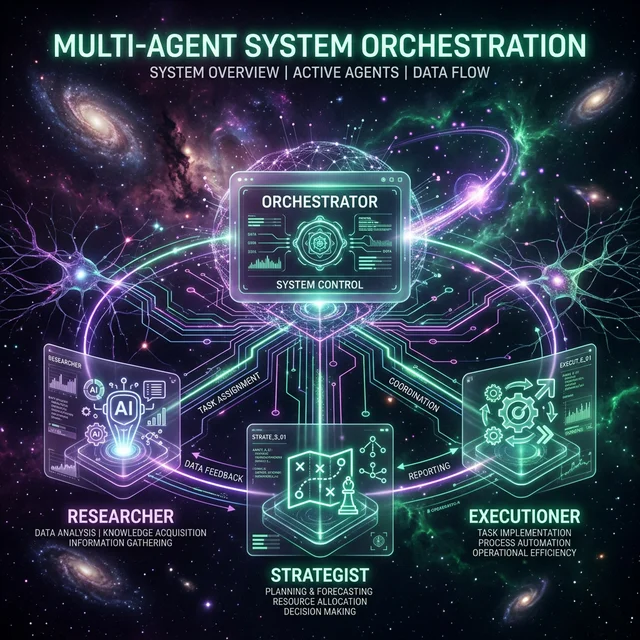
Unlike the rigid automation of the past, today's software agents are part of an 'Agentic Mesh.' They communicate with each other, negotiate deadlines, and even request 'human-in-the-loop' verification for high-stakes decisions. A modern marketing department might consist of one human director overseeing a fleet of agents specialized in market research, content generation, and media buying. This hierarchy allows for 24/7 operations and unprecedented scale with minimal overhead.
The Rise of 'Power Skills'
As agents take over the technical and repetitive work, the value of 'Power Skills' has skyrocketed. Leadership in 2026 is less about doing and more about 'Orchestration.' The most successful professionals are those who excel at emotional intelligence, strategic empathy, and most importantly, the ability to architect complex workflows that leverage both human creativity and agentic speed. The job market isn't shrinking; it's evolving into a management-first economy.
What Software Agents Are Replacing
Software agents are being deployed for tasks previously requiring a human employee. The clearest 2026 examples:
Customer support — Klarna reported in early 2024 that its AI assistant handled the equivalent work of 700 full-time agents. The pattern has spread: most major e-commerce platforms now route simple queries (order status, returns, password resets) to AI agents with human escalation only for complex cases.
Software quality assurance — AI agents run test suites, interpret failures, generate new test cases, and file bug reports autonomously. Several software companies have reduced QA headcount while increasing test coverage.
Data analysis and reporting — Recurring data pulls, dashboard generation, and routine reporting workflows are automated by agents that pull from APIs, generate analysis, and distribute results on schedule.
What the Workforce Impact Actually Looks Like
The "second workforce" narrative risks overstating displacement. In most deployments, AI agents handle a subset of a role's tasks, not the entire role. A customer service team using AI agents shifts in composition: fewer agents handle more contacts, with humans spending time on complex cases rather than routine queries. Headcount typically declines through attrition rather than layoffs.
The accurate framing: software agents expand organisational output capacity without proportionally expanding headcount — a productivity improvement that looks different depending on your lens: the organisation sees more output at the same cost; the labour market sees slower hiring for specific roles.
What Cannot Be Fully Automated Yet
The tasks AI agents struggle most with: those requiring empathy and emotional intelligence (handling distressed customers, sensitive HR conversations), those requiring judgment about unstated context, and those involving novel situations outside the agent's training distribution. The "second workforce" is genuinely productive for well-defined, high-volume, routine work — not yet a replacement for human judgment in complex, contextual situations.
How to Prepare as an Individual
For individuals whose roles include a significant proportion of the high-volume, routine tasks most susceptible to AI automation: the adaptation strategy is to develop skills in the areas AI agents remain weakest — complex judgment in novel situations, stakeholder relationship management, creative problem framing, and oversight of AI systems themselves. People who can effectively review, correct, and direct AI agents are more valuable than those who simply perform the tasks agents now handle. The transition is gradual enough that proactive skill development is a better response than alarm — but the transition is real enough that complacency is not appropriate.































































Commenting is currently unavailable on this article.