Mimicking Biology for Better Compute
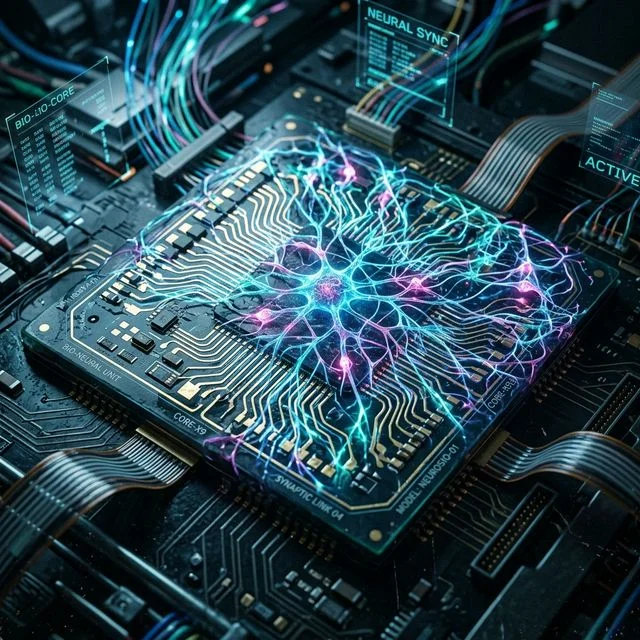
As LLMs continue to scale, the energy cost of traditional binary computing has become a global bottleneck. Enter Neuromorphic Computing. Unlike traditional CPUs and GPUs, these 'silicon brains' process information using 'spiking neural networks' that mimic how human neurons communicate. This breakthrough is enabling AI at the edge with unprecedented efficiency.
The End of the Heat Barrier
By only consuming power when a 'neuron' spikes, neuromorphic chips like the new 'Aether-7' effectively eliminate the heat issues associated with high-frequency inference. This allows for 6G AI-native systems to be integrated into even the smallest wearable devices without significant battery drain.
Scaling Toward AGI
Many researchers believe neuromorphic architecture is the true path to Artificial General Intelligence (AGI). By aligning hardware closer to natural intelligence, we are seeing breakthroughs in sensory processing and emotional context. This is the foundation for the next wave of Physical AI robotics that will require massive onboard intelligence with minimal power requirements.
The Key Players Driving the Field
Intel's Loihi 3 chip and IBM's NorthPole processor are the most commercially mature neuromorphic architectures as of 2026, both targeting edge inference workloads where power efficiency matters more than raw throughput. Several well-funded startups — including BrainChip and SpiNNcloud — are targeting industrial IoT and autonomous vehicle sensor fusion, where the ability to process data locally without a cloud round-trip is a decisive advantage. The global neuromorphic computing market is projected to exceed $9 billion by 2028, up from under $1 billion in 2023, according to industry forecasts.
Why This Matters for AI's Energy Problem
The energy cost of large language model inference has become a genuine sustainability concern. A single complex query to a frontier LLM consumes roughly 10 times the energy of a standard web search. Neuromorphic chips that handle inference tasks at a fraction of the power draw are therefore not just a performance story — they're an environmental one. Data centre operators and hyperscalers are watching neuromorphic developments closely, though most analysts expect a hybrid deployment model (GPUs for training, neuromorphic for edge inference) to dominate over the next five years rather than a wholesale architectural replacement.
How Neuromorphic Chips Differ From GPUs
A conventional GPU processes calculations sequentially through millions of transistors clocked at high frequency, using significant power even when most processing units are idle. A neuromorphic chip mimics the brain's sparse-activation principle: most processing elements (artificial neurons) are off at any given moment, activating only when a signal reaches them. This "event-driven" processing means energy is consumed only where and when computation is actually happening, rather than continuously.
Intel's Loihi 3 chip (announced early 2026) demonstrates the advantage quantitatively: it processes standard pattern recognition tasks at roughly 1,000x lower energy per inference than a GPU, at the cost of requiring specialised programming models that differ substantially from conventional neural network frameworks.
The Current Application Landscape
Neuromorphic chips are production-ready today for a specific class of tasks: real-time sensor processing where ultra-low latency and low power consumption matter more than peak throughput. Deployed applications include:
Auditory processing (wake-word detection, sound classification) in IoT devices — the Intel Movidius Neural Compute Stick has used neuromorphic elements for years. Anomaly detection in industrial sensor networks, where the chip monitors vibration or temperature patterns continuously and activates downstream processing only on anomaly detection. Edge robotics applications where battery life constrains conventional GPU use.
What Remains Hard
Programming neuromorphic chips requires a fundamentally different mental model from standard deep learning. PyTorch and TensorFlow don't map cleanly to spiking neural network architectures. Specialist tools (Intel's Lava framework, IBM's Neuroflow) exist but have small developer communities compared to mainstream AI tooling. Until neuromorphic chips can run conventional trained models with minimal conversion overhead, their adoption will remain niche — an efficiency win for specialists rather than a mainstream AI hardware option.





























































Commenting is currently unavailable on this article.