The Power Problem AI Can't Outrun
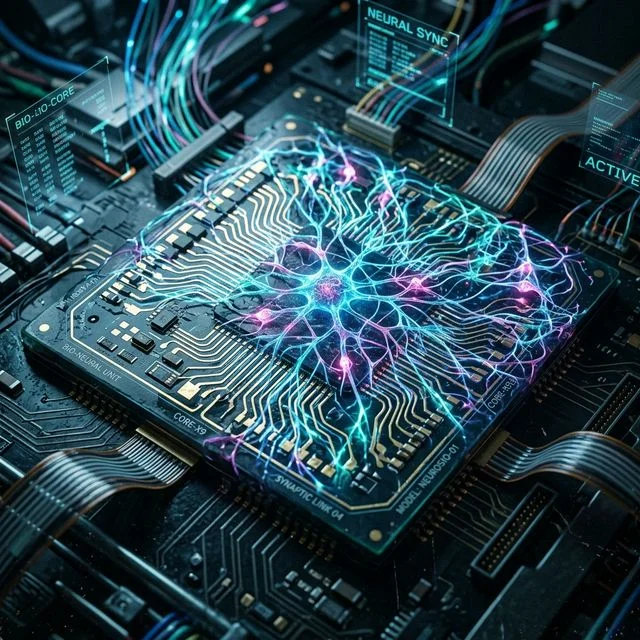
The dominant AI hardware story of the past few years has been about scale — more GPUs, bigger data centers, more electricity. But a quieter, parallel story has been building around the opposite goal: chips designed not to be the fastest, but the most efficient, by borrowing architectural ideas from how biological brains process information.
What Makes Neuromorphic Chips Different
Conventional AI chips shuttle enormous amounts of data between memory and processing units, which is where most of the energy goes. Neuromorphic designs integrate memory and computation more tightly and use event-driven, spike-based signaling instead of constantly recalculating — closer to how neurons fire only when needed rather than running on a fixed clock. The result, in early benchmarks, is AI inference at a small fraction of the power draw of conventional chips for certain workloads.
Where They're Actually Showing Up
The practical applications so far are squarely about constrained environments: hearables and smart glasses that need always-on sensing without draining a battery in hours, industrial sensors monitoring equipment in the field, and edge devices doing simple pattern recognition without a cloud connection. These aren't replacing data-center AI training — they're solving a different problem entirely.
The Honest Limitations
Neuromorphic chips remain harder to program than conventional accelerators; the software tooling and developer ecosystem are years behind GPUs, and most large language model workloads don't map cleanly onto spike-based architectures yet. This is a genuinely promising but still narrow technology, not an imminent replacement for the chips powering today's largest AI models.
Why It's Worth Watching Anyway
As AI moves further onto personal devices — glasses, earbuds, wearables where battery life is the binding constraint — efficiency-first chip architectures become more relevant, not less. Expect this category to grow steadily in specific niches rather than break out as a mainstream replacement for conventional AI hardware in the near term.
The Power Constraint Driving Demand
The fundamental problem neuromorphic chips address is the energy cost of intelligence at the edge. A standard GPU inference call consumes 150–400 watts. An ARM Cortex-based microcontroller running a small neural network consumes 0.5–5 watts. A neuromorphic chip can process equivalent tasks in the 1–100 milliwatt range — orders of magnitude more efficient, enabling AI inference in devices powered by small batteries or energy harvesting.
This power advantage unlocks specific device categories that conventional AI silicon cannot serve: continuous always-on sensor processing (smoke detectors, health monitors, industrial predictive maintenance sensors), brain-computer interfaces (where implanted devices have hard power constraints), and satellite-based edge AI nodes that rely on solar power and cannot accommodate high-draw processors.
The Specific Chips in Production
Intel Loihi 2 — Intel's second-generation neuromorphic chip, available through its Intel Neuromorphic Research Community programme. 1 million artificial neurons, 6 billion synapses, fabricated on Intel's 4nm process. Not yet commercially available as a standalone product.
BrainScaleS — European research platform from Heidelberg University, focused on ultra-fast emulation of biological neural dynamics. Research-only.
SpiNNaker (Manchester University) — Large-scale spiking neural network platform used primarily for computational neuroscience research.
Commercial neuromorphic silicon in production devices is currently embedded as IP blocks within larger chips rather than as standalone neuromorphic processors. Qualcomm's Snapdragon AI architecture includes neuromorphic-inspired spike-processing elements in its Hexagon NPU. Apple's Neural Engine has specific circuits for event-driven processing. The pure-play neuromorphic product category is still primarily research-grade; the ideas are entering production via integration into conventional AI chip architectures.
Why the Timing Is Right Now: The convergence of three trends is driving neuromorphic interest: battery-powered device categories are proliferating (earbuds, smart glasses, health monitors); on-device AI inference demand is growing rapidly in these same categories; and conventional AI chip architectures are hitting power-efficiency limits. The market opportunity for neuromorphic silicon is largest precisely where conventional approaches are worst — always-on, low-power, real-time sensor processing at the edge.





























































Commenting is currently unavailable on this article.