
Why the EU Keeps Winning Against Big Tech
Since 2017, the European Commission has imposed more than €10 billion in antitrust fines on Google alone, forced Apple to make structural changes to the App Store across Europe, and compelled Amazon, Meta, and Microsoft to modify practices in their European operations. US technology companies that have treated the EU as a secondary market have repeatedly discovered that it imposes real legal and financial costs.
This is not an accident. The EU has spent decades developing antitrust enforcement tools specifically suited to platform markets and has used them more aggressively than the US or UK equivalents. Understanding how that system works explains why EU enforcement produces outcomes that American regulators often cannot achieve.
The Two Tracks: Antitrust Cases vs the DMA
The EU's approach to big tech regulation operates on two parallel tracks that are worth distinguishing.
Track 1: Traditional antitrust enforcement (Articles 101 and 102 TFEU) — These are case-by-case investigations into specific anti-competitive practices. The European Commission investigates, issues a Statement of Objections, allows the company to respond, then issues a Decision (with or without a fine). The company can appeal to the General Court of the EU and, further, to the Court of Justice of the EU (CJEU). This process typically takes 5–10 years.
Track 2: Digital Markets Act (DMA) — A structural regulation that came into force in March 2024. Rather than requiring the Commission to prove harm case by case, the DMA designates companies meeting certain size thresholds as "gatekeepers" and imposes standing obligations on how they can operate specific "core platform services." Violations can be sanctioned more quickly than in traditional antitrust cases.
The Google Android case that concluded in July 2026 (€4.1 billion fine) was a traditional antitrust case under Track 1, taking approximately 8 years from investigation to final CJEU ruling. The DMA was designed to prevent needing similar 8-year cycles in the future.
How a Traditional Antitrust Case Works
Investigation phase — The Commission (through its Directorate-General for Competition, DG COMP) receives a complaint or opens an investigation on its own initiative. It has extensive powers: it can demand documents, conduct "dawn raids" (unannounced searches of company offices), and compel testimony from employees. In the digital sector, the Commission typically investigates for 2–4 years before issuing formal charges.
Statement of Objections — The Commission issues a formal document describing the practices it considers anti-competitive and the likely legal assessment. The company has the right to respond in writing and to be heard in an oral hearing.
Commission Decision — After reviewing the response, the Commission issues a formal decision. If it finds a violation, it can impose fines and require remedies (behavioural changes, structural divestitures). Fines can reach 10% of the company's worldwide annual turnover.
Appeal to the General Court — The company can appeal to the General Court of the EU, which can uphold, reduce, or annul the decision. This process takes 2–4 years.
Further appeal to the CJEU — On points of law, the company can appeal further to the Court of Justice. This is the final stage, as illustrated by the Google Android case.
What the Digital Markets Act Changes
The DMA fundamentally changes the pace and nature of enforcement by replacing the reactive case-by-case model with proactive, prospective obligations.
Gatekeeper designation — Companies operating core platform services (online search, social networks, app stores, cloud services, messaging, virtual assistants, browsers, operating systems) and meeting size thresholds (€7.5 billion annual EU revenue or €75 billion market cap, with 45 million+ monthly EU users) are designated "gatekeepers." Six companies received initial gatekeeper designations: Alphabet, Amazon, Apple, ByteDance, Meta, and Microsoft.
Standing obligations — Designated gatekeepers must comply with a list of obligations and prohibitions without the Commission needing to prove harm. These include: allowing app stores to sell apps sideloaded from outside the gatekeeper's store; not preferencing the gatekeeper's own services over competitors in ranking; not tracking users for advertising across services without explicit consent; ensuring interoperability with competing messaging services.
Faster enforcement — The Commission can impose interim measures and non-compliance fines (up to 10% of global turnover; up to 20% for repeat violations) through proceedings significantly faster than traditional antitrust cases.
Structural remedies — In cases of systematic non-compliance, the DMA allows the Commission to impose behavioural or structural remedies including, in extreme cases, mandatory divestiture.
Cases in Progress in 2026
Apple (App Store / DMA) — Apple paid a €500 million DMA fine in early 2025 for its approach to complying with the app store interoperability obligation. The Commission found Apple's implementation — which imposed a "core technology fee" on alternative app stores — did not constitute genuine compliance. Further enforcement proceedings are ongoing.
Meta (advertising data / DMA) — The Commission issued preliminary findings in 2025 that Meta's "pay or consent" model (requiring users to either pay for ad-free Facebook or consent to ad tracking) violates the DMA's consent requirements. Decision pending.
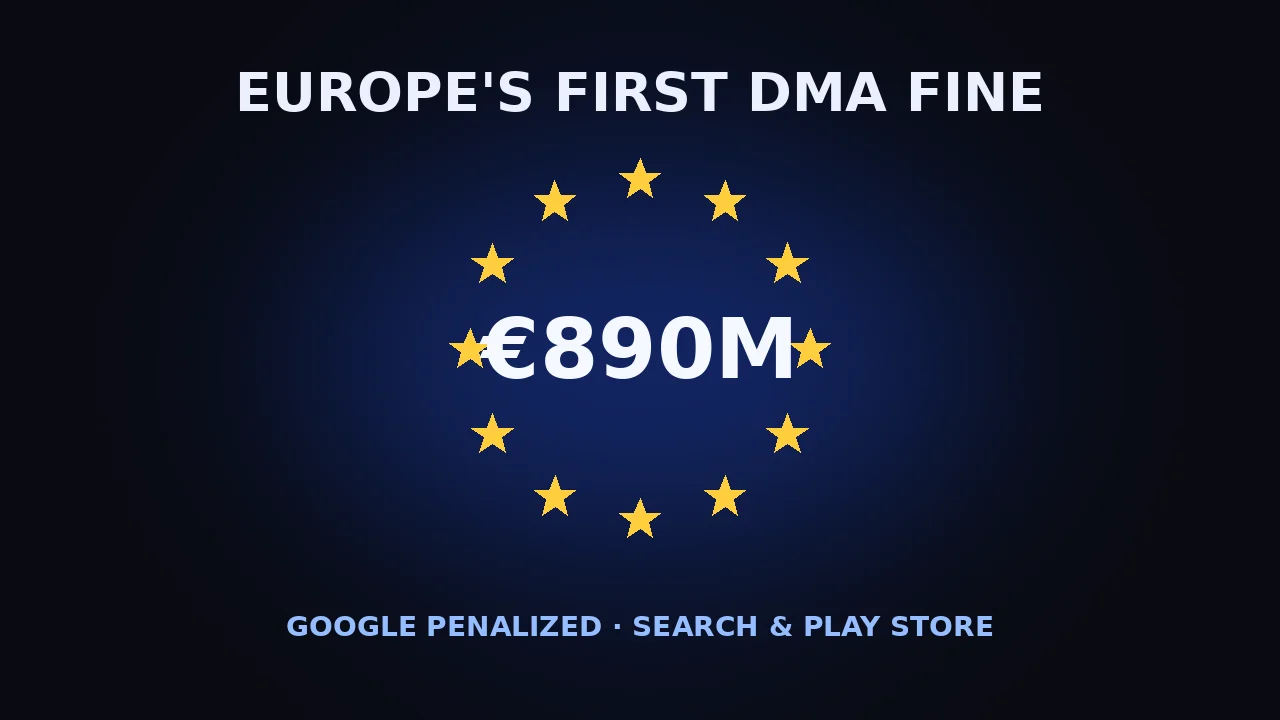
Google (Search / DMA) — Despite the Android antitrust case now concluded, the Commission has opened a DMA investigation into Google's Search practices, specifically whether it preferences its own vertical search services (Shopping, Hotels, Flights) over competitors.
Apple (browser / DMA) — Investigation into whether Apple's Safari browser default practices in iOS comply with DMA browser choice screen requirements.
Why US Companies Keep Losing
European courts are not inherently hostile to American companies — they apply European law, which the companies accepted when they entered European markets. Several structural factors explain why EU enforcement has been more successful than US enforcement in this domain:
Broader harm theory — EU competition law permits harm-to-competition theories that the narrow consumer welfare standard dominant in US antitrust often excludes. The EU can find abuse where a practice harms competing businesses even if consumer prices haven't risen.
Extraterritorial jurisdiction — The EU applies its rules to any conduct that affects competition within the EU, regardless of where the company is headquartered. US companies must comply with EU law to operate in European markets.
Structural separation tools — The DMA includes structural remedy powers that US antitrust courts have been reluctant to impose without clear precedent for monopoly harm.
Political will — EU competition policy has consistently had strong political backing from the European Parliament and member state governments. Margrethe Vestager (EU Commissioner for Competition 2014–2024) became the global symbol of big tech enforcement. Her successor, Teresa Ribera, has indicated continuity.
The Bottom Line
EU antitrust enforcement is genuinely effective — not primarily as a deterrent (fines, even at €4 billion, represent manageable costs for trillion-dollar companies) but as a mechanism for forcing structural and behavioural changes that reshape how platforms operate in their largest markets. The DMA represents an escalation: moving from punishing past behaviour to prospectively requiring different behaviour, enforced with faster procedures and larger potential penalties. For companies operating major platform services in Europe, DMA compliance is now a permanent operating obligation, not a litigation risk to be managed.






























































Commenting is currently unavailable on this article.