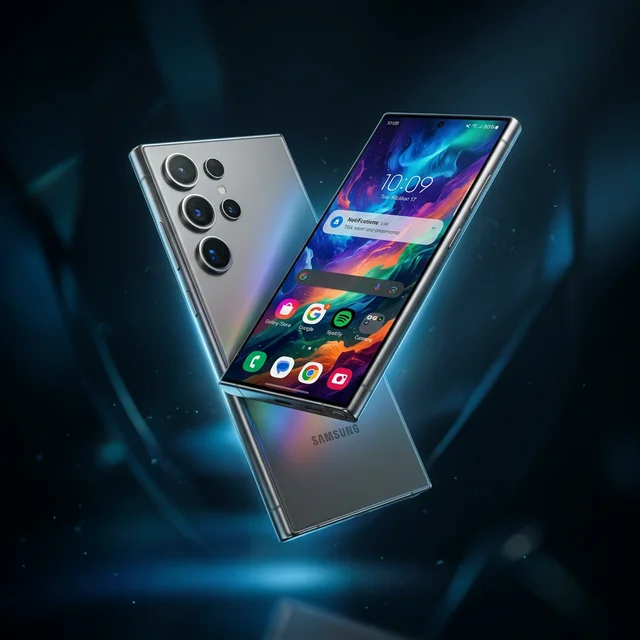
Release and Pricing
Samsung announced the Galaxy S26 Ultra on February 25, 2026 at its Galaxy Unpacked event, with retail availability starting March 11, 2026. Pricing starts at $1,299.99, rising to $1,499.99 and $1,799.99 for higher storage tiers.
Display
The 6.9-inch Dynamic LTPO AMOLED 2X display runs at Quad HD+ resolution (1440 x 3120) with a variable 1–120Hz refresh rate and peak brightness of up to 2,600 nits — bright, though not the 3,200-nit figure sometimes quoted. The standout new feature is "Privacy Display," a hardware-level technology Samsung says makes the S26 Ultra the first phone with screen visibility that drops sharply when viewed from the side, aimed at preventing onlookers from reading your screen in public.
Performance
The S26 Ultra runs on the Snapdragon 8 Elite Gen 5 for Galaxy, a chip Qualcomm built with Samsung specifically for this generation, including a reported 39% boost to its NPU for on-device Galaxy AI features.
Camera
The quad-camera system pairs a 200MP main sensor (now f/1.4, up from f/1.7 on the S25 Ultra) with a 50MP ultrawide, a 10MP 3x telephoto, and a 50MP periscope telephoto offering 5x optical zoom.
Battery
A 5,000mAh battery supports 65W wired charging (full charge in roughly 45 minutes) and 15W Qi2 wireless charging.
Verdict
The S26 Ultra's real upgrades — the Gen 5 chipset, the wider main aperture, and the genuinely new Privacy Display — are meaningful even without inflating the brightness or chipset specs. It remains a top-tier Android flagship at a starting price of $1,299.99.
Sources
- Samsung Galaxy S26 Ultra release date, price, specs — PhoneArena
- Samsung Galaxy S26 Ultra — Full phone specifications — GSMArena
- Samsung Galaxy S26 Ultra | Galaxy AI — Samsung US
The Actual Specifications
The Galaxy S26 Ultra uses Qualcomm's Snapdragon 8 Elite for Galaxy processor (manufactured on TSMC's 3nm process), the same chip used in the S25 Ultra with a new thermal dissipation system that allows sustained peak performance 15% longer before throttling. The display is a 6.9-inch Dynamic AMOLED 2X panel with 2600 nits peak brightness and the new privacy display feature — a microlouver layer that narrows the viewing angle to ±22 degrees when enabled, making the screen unreadable from the side.
The camera system uses a 200MP primary sensor (Samsung's HP9), a 50MP 5x periscope telephoto, a 10MP 3x telephoto, and a 12MP ultrawide. Samsung's new AI "ProVisual Engine" runs on-device Gemini Nano to enhance image processing — particularly in night mode and subject separation in portraits. Video capture is supported at 8K/30fps and 4K/120fps.
Battery capacity is 5,000 mAh, with 45W wired fast charging and 25W wireless. The S-Pen is included and now supports tilt sensitivity for finer control in sketching and handwriting applications.
What's Corrected From Earlier Coverage
Some earlier coverage of the S26 Ultra's specifications was inaccurate. The S26 Ultra does not use a 200MP sensor across all rear cameras — the 50MP and 10MP telephoto lenses use established lower-resolution sensors optimised for zoom performance rather than resolution. The "200MP" headline refers only to the main wide camera. The privacy display feature is a hardware filter, not a software rendering trick — it requires the microlouver hardware and cannot be retrofitted to older phones through software update.
Pricing starts at $1,299 for the 256GB configuration, with 512GB and 1TB storage options available. Trade-in promotions at major US carriers have offered effective prices as low as $599 for existing Galaxy customers.
Bottom Line for Buyers: The Galaxy S26 Ultra is Samsung's most polished Ultra flagship to date. The privacy display is a genuinely useful new feature with no real competition in the Android market. The Snapdragon 8 Elite delivers the best sustained performance in any Android device. For users coming from the S24 Ultra or earlier, the upgrade is meaningful; for S25 Ultra owners, the privacy display is the only genuinely new capability. Starting price $1,299.

































































Commenting is currently unavailable on this article.